


Page 55 - All About History - Issue 08-14
P. 55
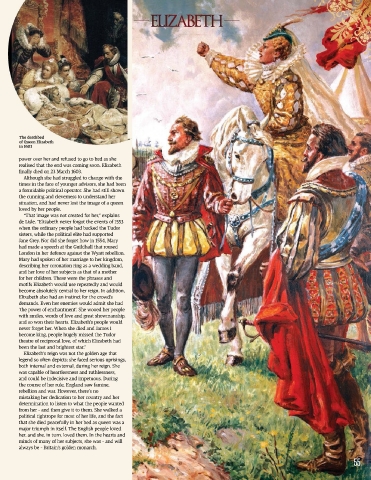
The deathbed
        of Queen Elizabeth
        in 1603
        power over her and refused to go to bed as she
        realised that the end was coming soon. Elizabeth
        finally died on 23 March 1603.
         Although she had struggled to change with the
        times in the face of younger advisors, she had been
        a formidable political operator. She had still shown
        the cunning and cleverness to understand her
        situation, and had never lost the image of a queen
        loved by her people.
         “That image was not created for her,” explains
        de Lisle. “Elizabeth never forgot the events of 1553
        when the ordinary people had backed the Tudor
        sisters, while the political elite had supported
        Jane Grey. Nor did she forget how in 1554, Mary
        had made a speech at the Guildhall that roused
        London in her defence against the Wyatt rebellion.
        Mary had spoken of her marriage to her kingdom,
        describing her coronation ring as a wedding band,
        and her love of her subjects as that of a mother
        for her children. These were the phrases and
        motifs Elizabeth would use repeatedly and would
        become absolutely central to her reign. In addition,
        Elizabeth also had an instinct for the crowd’s
        demands. Even her enemies would admit she had
        ‘the power of enchantment’. She wooed her people
        with smiles, words of love and great showmanship,
        and so won their hearts. Elizabeth’s people would
        never forget her. When she died and James I
        become king, people hugely missed the Tudor
        theatre of reciprocal love, of which Elizabeth had
        been the last and brightest star.”
         Elizabeth’s reign was not the golden age that
        legend so often depicts; she faced serious uprisings,
        both internal and external, during her reign. She
        was capable of heartlessness and ruthlessness,
        and could be indecisive and impetuous. During
        the course of her rule, England saw famine,
        rebellion and war. However, there’s no
        mistaking her dedication to her country and her
        determination to listen to what the people wanted
        from her – and then give it to them. She walked a
        political tightrope for most of her life, and the fact
        that she died peacefully in her bed as queen was a
        major triumph in itself. The English people loved
        her, and she, in turn, loved them. In the hearts and
        minds of many of her subjects, she was – and will
        always be – Britain’s golden monarch.
                                                                                                                             55

