


Page 66 - All About History - Issue 08-14
P. 66
Wrath of the Khans


              Mongol horsemen                                      BORN TO FIGHT              GENERAL CHARACTERISTICS

                                                                   In Mongol society, all men between
                                                                                              Each warrior was responsible for his
                                                                   the ages of 16 and 60 who were   own food and equipment and had
                                                                   physically fit to fight were warriors.   at least three reserve horses. By
           The army created by Genghis Khan   following Genghis – including his
           was almost exclusively made up of   grandson Kublai – did not significantly   Some 60% of the Mongol cavalry was   constantly changing their mount, they
                                                                   light and 40% heavy, although they   travelled enormous distances in a very
           cavalrymen divided into heavy  change the structure of the Mongolian
           and light cavalry. Its power lay in   horsemen. Although Kublai Khan was   complemented each other tactically,  short time.
                                                                   combining the shock power of the
           its mobility, the effectiveness of its   involved in fewer battles than his
           specifically created tactics and that   predecessors he did use the famous   latter with the rain of arrows of the   INSIGNIA
                                                                   former. The riders were so skilled with
           it was a highly qualified army for   horsemen in his invasions of Japan,           The Black Standard or Khar
           the type of war it fought. The rulers   Burma and Vietnam.  the bow and arrow that they could   Sulde. Made from horsehair,
                                                                   load and fire while at a gallop with
                                                                   almost infallible precision.  it was only used for war.
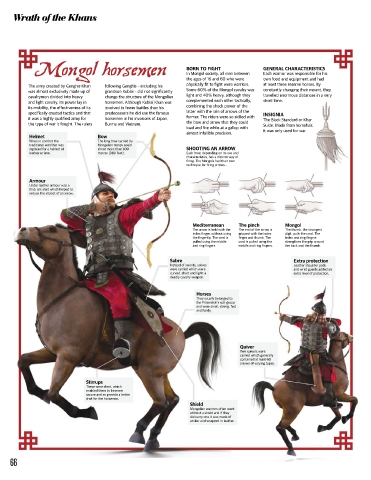
           Helmet                  Bow
           When in combat the      The long bow carried by
           traditional wool hat was   Mongolian troops could
           replaced for a helmet of   shoot more than 300          SHOOTING AN ARROW
           leather or iron.        metres (980 feet).              Each bow, depending on its use and
                                                                   characteristics, has a distinct way of
                                                                   firing. The Mongols had their own
                                                                   technique for firing arrows…
           Armour
           Under leather armour was a
           thick silk shirt which helped to
                                                                                     The pinch       Mongol
           reduce the impact of an arrow.


                                                                     Mediterranean
                                                                     The arrow is held with the
                                                                                     gripped with the index
                                                                                                     digit, pulls the cord. The
                                                                     index finger, without using
                                                                     the fingertip. The cord is
                                                                                                     index and ring fingers
                                                                                     finger and thumb. The
                                                                                                     strengthen the grip around
                                                                     pulled using the middle  The end of the arrow is   The thumb, the strongest
                                                                                     cord is pulled using the
                                                                     and ring fingers.   middle and ring fingers.  the back and the thumb.
                                                             Sabre                                      Extra protection
                                                             Instead of swords, sabres                  Leather shoulder pads
                                                             were carried which were                    and wrist guards added an
                                                             curved, short and light: a                 extra level of protection.
                                                             deadly cavalry weapon.
                                                                      Horses
                                                                      They usually belonged to
                                                                      the Przewalski’s sub-group
                                                                      and were small, strong, fast
                                                                      and hardy.


                                                                                     Quiver
                                                                                     Two quivers were
                                                                                     carried which generally
                                                                                     contained at least 60
                                                                                     arrows of varying types.

                               Stirrups
                               These were short, which
                               enabled them to be more
                               secure and so provide a better
                               shot for the horseman.
                                                                    Shield
                                                                    Mongolian warriors often went
                                                                    without a shield and if they
                                                                    did carry one it was made of
                                                                    wicker and wrapped in leather.


     66

