


Page 61 - All About History - Issue 08-14
P. 61
Hitler’s astronauts
                                                      CONTRACT 422-4593


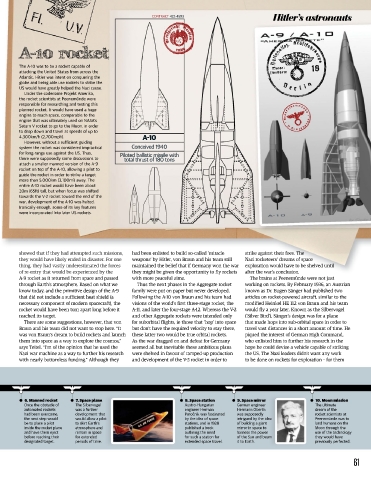
        A-10          rocket


        The A-10 was to be a rocket capable of
        attacking the United States from across the
        Atlantic. Hitler was intent on conquering the
        globe and being able use rockets to strike the
        US would have greatly helped the Nazi cause.
          Under the codename Projekt Amerika,
        the rocket scientists at Peenemünde were
        responsible for researching and testing this
        planned rocket. It would have used a huge
        engine to reach space, comparable to the
        engine that was ultimately used on NASA’s
        Saturn V rocket to go to the Moon, in order
        to drop down and travel at speeds of up to
        4,300km/h (2,700mph).                      A-10
          However, without a sufficient guiding
        system the rocket was considered impractical   Conceived 1940
        for long-range use against the US. Thus,   Piloted ballistic missile with
        there were supposedly some discussions to   total thrust of 180 tons
        attach a smaller manned version of the A-9
        rocket on top of the A-10, allowing a pilot to
        guide the rocket in order to strike a target
        more than 5,000km (3,100mi) away. The
        entire A-10 rocket would have been about

        20m (65ft) tall, but when focus was shifted
        towards the V-2 rocket toward the end of the
        war, development of the A-10 was halted.
        Ironically enough, some of its key features
        were incorporated into later US rockets.


        showed that if they had attempted such missions,   had been enlisted to build so-called ‘miracle   strike against their foes. The
        they would have likely ended in disaster. For one   weapons’ by Hitler, von Braun and his team still   Nazi rocketeers’ dreams of space
        thing, they had vastly underestimated the forces   maintained the belief that if Germany won the war   exploration would have to be shelved until
        of re-entry that would be experienced by the   they might be given the opportunity to fly rockets   after the war’s conclusion.
        A-9 rocket as it returned from space and passed   with more peaceful aims.       The brains at Peenemünde were not just
        through Earth’s atmosphere. Based on what we   Thus the next phases in the Aggregate rocket   working on rockets. By February 1936, an Austrian
        know today, and the primitive design of the A-9   family were put on paper but never developed.   known as Dr. Eugen Sänger had published two
        that did not include a sufficient heat shield (a   Following the A-10 von Braun and his team had   articles on rocket-powered aircraft, similar to the
        necessary component of modern spacecraft), the   visions of the world’s first three-stage rocket, the   modified Heinkel HE 112 von Braun and his team
        rocket would have been torn apart long before it   A-11, and later the four-stage A-12. Whereas the V-2   would fly a year later. Known as the Silbervogel
        reached its target.                    and other Aggregate rockets were intended only   (‘Silver Bird’), Sänger’s design was for a plane
         There are some suggestions, however, that von   for suborbital flights, ie those that ‘hop’ into space   that made hops into sub-orbital space in order to
        Braun and his team did not want to stop here. “It   but don’t have the required velocity to stay there,   travel vast distances in a short amount of time. He
        was von Braun’s dream to build rockets and launch   these latter two would be true orbital rockets.   piqued the interest of German High Command,
        them into space as a way to explore the cosmos,”   As the war dragged on and defeat for Germany   who enlisted him to further his research in the
        says Teitel. “I’m of the opinion that he used the   seemed all but inevitable these ambitious plans   hope he could devise a vehicle capable of striking
        Nazi war machine as a way to further his research   were shelved in favour of ramped-up production   the US. The Nazi leaders didn’t want any work
        with nearly bottomless funding.” Although they   and development of the V-2 rocket in order to   to be done on rockets for exploration – for them


        ●  6. Manned rocket  ●  7. Space plane                  ●  8. Space station  ●  9. Space mirror       ●  10. Moon mission
          Once the obstacle of   The Silbervogel                  Austro-Hungarian   German engineer            The ultimate
          automated rockets   was a further                       engineer Herman   Hermann Oberth              dream of the
          had been overcome,   development that                   Potočnik was fascinated   was supposedly      rocket scientists at
          the next step would   would allow a pilot               by the idea of space   intrigued by the idea   Peenemünde was to
          be to place a pilot   to skirt Earth’s                  stations, and in 1928   of building a giant   land humans on the
          inside the rocket plane   atmosphere and                published a book   mirror in space to         Moon through the
          and have them eject   remain in space                   outlining the need   harness the power        use of the technology
          before reaching their   for extended                    for such a station for   of the Sun and beam   they would have
          designated target.  periods of time.                    extended space travel.   it to Earth.         previously perfected.


                                                                                                                             61

