


Page 90 - All About History - Issue 08-14
P. 90
Witch-hunting


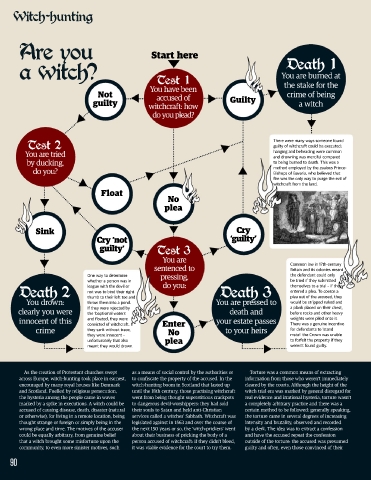
        Are you                                       Start here


                                                                                                      Death
                                                                                                                     1
        a Witch?                                        Test      1                                 You are burned at


                                                      You have been                                  the stake for the
                                                        accused   of
                                   Not                                                                crime of being
                                                                                  Guilty
                                                     witchcraft: how
                                  guilty                                                                  a  witch
                                                       do you plead?


           Test 2                                                                                There were many ways someone found
                                                                                                 guilty of witchcraft could be executed:
          You are tried                                                                          hanging and beheading were common
                                                                                                 and drowning was merciful compared
          by ducking,                                                                            to being burned to death. This was a
                                                                                                 method employed by the zealous Prince-
             do you?                                                                             Bishops of Bavaria, who believed that
                                                                                                 fire was the only way to purge the evil of
                                                                                                 witchcraft from the land.

                                     Float
                                                            No
                                                           plea


              Sink                                                                  Cry
                                                                                  ‘guilty’
                                   Cry ‘not
                                                        Test 3
                                    guilty’
                                                          You  are
                                                                                                       Common law in 17th-century
                                                       sentenced   to                                  Britain and its colonies meant
                                One way to determine     pressing,                                     the defendant could only
                                whether a person was in   do  you:                                     be tried if they submitted
                                                                                                       themselves to a trial – if they
        Death 2                 league with the devil or                      Death 3                  entered a plea. To coerce a
                                not was to bind their right
                                                                                                       plea out of the accused, they
          You  drown:           thumb to their left toe and                  You are pressed to        would be stripped naked and
                                throw them into a pond.
                                If they were rejected by                                               a plank placed on their chest,
       clearly you were         the ‘baptismal waters’                            death  and           before rocks and other heavy
        innocent of this        and floated, they were                       your estate passes        weights were piled onto it.
                                convicted of witchcraft. If                                            There was a genuine incentive
                                                          Enter
              crime             they sank without trace,                        to your heirs          for defendants to ‘stand
                                they were innocent –        No                                         mute’: the Crown was unable
                                unfortunately that also                                                to forfeit the property if they
                                                           plea
                                meant they would drown.                                                weren’t found guilty.


          As the creation of Protestant churches swept   as a means of social control by the authorities or   Torture was a common means of extracting
        across Europe, witch-hunting took place in earnest,   to confiscate the property of the accused. In the   information from those who weren’t immediately
        encouraged by many royal houses like Denmark   witch-hunting boom in Scotland that lasted up   cleared by the courts. Although the height of the
        and Scotland. Fuelled by religious persecution,   until the 18th century, those practising witchcraft   witch trial era was marked by general disregard for
        the hysteria among the people came in waves   went from being thought superstitious crackpots   real evidence and irrational hysteria, torture wasn’t
        marked by a spike in executions. A witch could be   to dangerous devil-worshippers: they had sold   a completely arbitrary practice and there was a
        accused of causing disease, death, disaster (natural   their souls to Satan and held anti-Christian   certain method to be followed: generally speaking,
        or otherwise), for living in a remote location, being   services called a witches’ Sabbath. Witchcraft was   the torture came in several degrees of increasing
        thought strange or foreign or simply being in the   legislated against in 1563 and over the course of   intensity and brutality, observed and recorded
        wrong place and time. The motives of the accuser   the next 150 years or so, the ‘witch-prickers’ went   by a clerk. The idea was to extract a confession
        could be equally arbitrary, from genuine belief   about their business of pricking the body of a   and have the accused repeat the confession
        that a witch brought some misfortune upon the   person accused of witchcraft: if they didn’t bleed,   outside of the torture: the accused was presumed
        community, to even more sinister motives, such   it was viable evidence for the court to try them.   guilty and often, even those convinced of their
     90

