


Page 89 - All About History - Issue 08-14
P. 89
Witch-hunting


                                                                                  Who  Were                      the


                                                                                  Witch-hunters?


                                                                                  The Witch-Finder General England
                                                                                                    Matthew Hopkins, the self-
                                                                                                    titled ‘Witch-Finder General’,
                                                                                                    was an English witch-hunter
                                                                                                    who was active from 1644-
                                                                                                    1647, during which time
                                                                                                    he was responsible for the
                                                                                                    execution of 300 convicted
                                                                                                    witches. He introduced
                                                                                                    many witch tests that could
                                                                                                    be considered farcical if
                                                                                                    it weren’t for their dire
                                                                                  consequences. His work was sanctioned by Parliament,
                                                                                  but he quickly gained a bad reputation for his
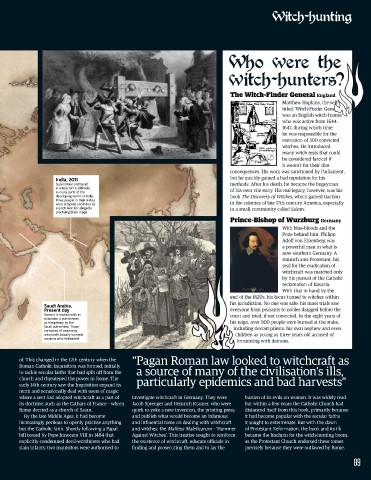
                     India, 2011
                     Superstition and belief                                      methods. After his death, he became the bogeyman
                     in witchcraft is still held
                                                                                  Prince-Bishop of Wurzburg Germany
                     in many parts of the                                         of his own vile story. His real legacy, however, was his
                     developing world. In India,                                  book The Discovery of Witches, which gained traction
                     three people in their sixties
                     were attacked and killed by                                  in the colonies of late 17th-century America, especially
                     a lynch mob for allegedly                                    in a small community called Salem.
                     practising black magic.
                                                                                                    With blue-bloods and the
                                                                                                    Pope behind him, Philipp
                                                                                                    Adolf von Ehrenberg was
                                                                                                    a powerful man in what is
                                                                                                    now southern Germany. A
                                                                                                    staunch anti-Protestant, his
                                                                                                    zeal for the eradication of
                                                                                                    witchcraft was matched only
                                                                                                    by his pursuit of the Catholic
                                                                                                    reclamation of Bavaria.
                                                                                                    With that in hand by the
                                                                                  end of the 1620s, his focus turned to witches within
                                                                                  his jurisdiction. No one was safe: his mass trials saw
                 Saudi Arabia,
                 Present day                                                      everyone from peasants to nobles dragged before the
                 Sorcery is treated with as                                       court and tried, if not convicted. In the eight years of
                 draconian a punishment
                 as blasphemy by the                                              his reign, over 900 people were burned at the stake,
                 Saudi authorities. Those
                 convicted of practising                                           including devout priests, his own nephew and even
                 witchcraft (usually women)                                         children as young as three years old accused of
                 are invariably beheaded.
                                                                                    fornicating with demons.
        of. This changed in the 12th century when the   “ Pagan Roman law looked to witchcraft as
        Roman Catholic Inquisition was formed, initially
        to tackle secular faiths that had split off from the   a source of many of the civilisation’s ills,
        church and threatened the power in Rome. The   particularly epidemics and bad harvests”
        early 14th century saw the Inquisition expand its
        remit and occasionally deal with users of magic
        where a sect had adopted witchcraft as a part of   investigate witchcraft in Germany. They were   burden of its evils on women. It was widely read
        its doctrine, such as the Cathars of France – whom   Jacob Sprenger and Heinrich Kramer, who were   but within a few years the Catholic Church had
        Rome decried as a church of Satan.     quick to yoke a new invention, the printing press,   distanced itself from this book, primarily because
          By the late Middle Ages, it had become   and publish what would become an infamous   it had become popular with the secular faiths
        increasingly perilous to openly practise anything   and influential tome on dealing with witchcraft   it sought to exterminate. But with the dawn
        but the Catholic faith. Shortly following a Papal   and witches: the Malleus Maleficarum – ‘Hammer   of Protestant Reformation, the book and its ilk
        bill issued by Pope Innocent VIII in 1484 that   Against Witches’. This treatise sought to reinforce   became the linchpin for the witch-hunting boom,
        explicitly condemned devil-worshipers who had   the existence of witchcraft, educate officials in   as the Protestant Church endorsed these tomes
        slain infants, two inquisitors were authorised to   finding and prosecuting them and to lay the   precisely because they were outlawed by Rome.
                                                                                                                             89

