


Page 85 - All About History - Issue 08-14
P. 85
History's narrowest escapes


        HOW  A MOULDY
                                    MELON SAVED MILLIONS


             s the troops landed on the shores of
             Normandy on 6 June 1944, the medics who
             accompanied them carried a new weapon.
             It was not one that could be used against
        A the enemy, but it was the ultimate defence
        for soldiers who had been wounded.
          During the first 24 hours of the Normandy
        landings, there were around 12,000 Allied
        casualties. Yet some 3,000 lives were saved during
        Operation Overlord, thanks to the new wonder
        drug, which was able to fight infections. This new
        wonder drug was called penicillin and was first
        discovered in 1928.
          While studying influenza, British scientist
        Alexander Fleming went on holiday and upon
        returning noticed some blue-green mould growing
        in one of the petri dishes he had been using. The
        fungus had a bacteria-free area around it and
        Fleming realised that something in the mould
        must be killing the bacteria and found that the
        mould was penicillum notatum.
          Fleming may have discovered the new drug but
        it wasn’t until years afterwards that it would be
        developed into a workable antibiotic agent. In 1939,
        with war clouds gathering over Europe, Howard
        Florey, an Australian scientist took another look
        at Fleming’s work with the help of two other
        scientists, Ernst Chain and Norman Heatley.
        They ultimately developed a way to purify small
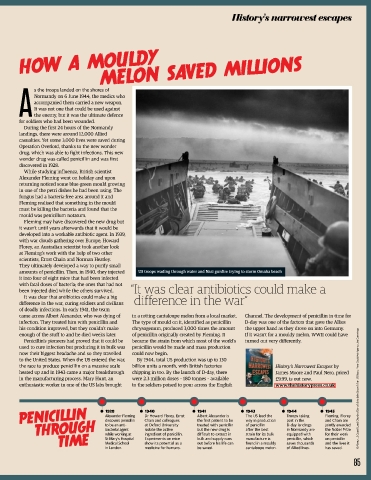
        amounts of penicillin. Then, in 1940, they injected   US troops wading through water and Nazi gunfire trying to storm Omaha beach
        it into four of eight mice that had been infected
        with fatal doses of bacteria; the ones that had not
        been injected died while the others survived.  “ It was clear antibiotics could make a
         It was clear that antibiotics could make a big
        difference in the war, curing soldiers and civilians  difference in the war”
        of deadly infections. In early 1941, the team
        came across Albert Alexander, who was dying of   in a rotting cantaloupe melon from a local market.   Channel. The development of penicillin in time for
        infection. They treated him with penicillin and   The type of mould on it, identified as penicillin   D-day was one of the factors that gave the Allies
        his condition improved, but they couldn’t make   chrysogenum, produced 3,000 times the amount   the upper hand as they drove on into Germany.
        enough of the stuff to and he died weeks later.   of penicillin originally created by Fleming. It   If it wasn’t for a mouldy melon, WWII could have
         Penicillin’s pioneers had proved that it could be   became the strain from which most of the world’s   turned out very differently.
        used to cure infection but producing it in bulk was   penicillin would be made and mass production
        now their biggest headache and so they travelled   could now begin.
        to the United States. When the US entered the war,   By 1944, total US production was up to 130
        the race to produce penicillin on a massive scale   billion units a month, with British factories   History’s Narrowest Escapes by
        heated up and in 1943 came a major breakthrough   chipping in too. By the launch of D-day, there   James Moore and Paul Nero, priced
        in the manufacturing process. Mary Hunt, an   were 2.3 million doses – 180 tonnes – available   £9.99, is out now.
        enthusiastic worker in one of the US labs brought   to the soldiers poised to pour across the English   www.thehistorypress.co.uk © Alamy; US Coast Guard; Church of Santa Maria delle Grazie, Milan; US Navy;  Peter Scott/Art Agency; Joe Cummings


                                    l  1928       l  1940            l  1941          l  1943       l  1944       l  1945
                                      Alexander Fleming   Dr Howard Florey, Ernst   Albert Alexander is   The US lead the   Troops taking   Fleming, Florey
                                      discovers penicillin   Chain and colleagues   the first patient to be   way in production   part in the   and Chain are
                                      to be an anti-  at Oxford University   treated with penicillin   of penicillin   D-day landings   jointly awarded
                                      bacterial agent   isolate the active   but the new drug is   after the best   in Normandy are   the Nobel Prize
                                      while working at   ingredient of penicillin.   difficult to extract in   strain for its bulk   equipped with   for their work
                                      St Mary’s Hospital   Experiments on mice   bulk and supply runs   manufacture is   penicillin, which   on penicillin
                                      Medical School    show its potential as a   out before his life can   found in a mouldy   saves thousands   and the lives it
                                      in London.    medicine for humans.  be saved.    cantaloupe melon.  of Allied lives.  has saved.
                                                                                                                             85

