


Page 88 - All About History - Issue 08-14
P. 88
Witch-hunting


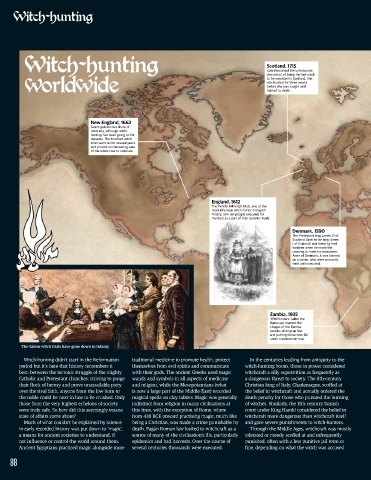
          Witch-hunting                                                                        Scotland, 1715

                                                                                               Kate Nevin had the unfortunate
                                                                                               distinction of being the last witch
          WorldWide                                                                            was hunted for three weeks
                                                                                               to be executed in Scotland. She
                                                                                               before she was caught and
                                                                                               burned to death.


                                 New England, 1662
                                 Salem gets its due share of
                                 notoriety, although witch-
                                 hunting had been going on for
                                 decades. The Hartford witch
                                 trials went on for several years
                                 and proved an interesting case
                                 of the witch-court’s rationale.


                                                                           England, 1612
                                                                           The Pendle Hill witch trials, one of the
                                                                           most infamous witch-hunts in English
                                                                           history, saw ten people executed for
                                                                           murders as a part of their Satanic rituals.
                                                                                                        Denmark, 1590
                                                                                                        The Protestant king James VI of
                                                                                                        Scotland (later to be king James
                                                                                                        I of England) was beset by bad
                                                                                                        weather when he made the
                                                                                                        crossing to meet his betrothed,
                                                                                                        Anne of Denmark. It was blamed
                                                                                                        on a coven, who were promptly
                                                                                                        tried and executed.


                                                                                                Zambia, 1935
                                                                                                ‘Witchfinders’ called the
                                                                                                Bamucapi roamed the
                                                                                                villages of the Bemba
                                                                                                people, stirring up fear
                                                                                                and putting those who fell
                                                                                                under suspicion on trial.
         The Salem witch trials have gone down in infamy
         Witch-hunting didn’t start in the Reformation   traditional medicine to promote health, protect   In the centuries leading from antiquity to the
        period but it’s here that history remembers it   themselves from evil spirits and communicate   witch-hunting boom, those in power considered
        best: between the tectonic struggle of the mighty   with their gods. The ancient Greeks used magic   witchcraft a silly superstition as frequently as
        Catholic and Protestant churches, striving to purge   wands and symbols in all aspects of medicine   a dangerous threat to society. The 8th-century
        their flock of heresy and prove unassailable piety   and religion, while the Mesopotamians (what   Christian king of Italy, Charlemagne, scoffed at
        over the rival faith, anyone from the low-born to   is now a large part of the Middle-East) recorded   the belief in witchcraft and actually ordered the
        the noble could be next in line to be crushed. Only   magical spells on clay tablets. Magic was generally   death penalty for those who pursued the burning
        those from the very highest echelons of society   indistinct from religion in many civilisations at   of witches. Similarly, the 11th-century Danish
        were truly safe. So how did this seemingly insane   this time, with the exception of Rome, where   court under King Harold considered the belief in
        state of affairs come about?           from 438 BCE onward practising magic, much like   witchcraft more dangerous than witchcraft itself
         Much of what couldn’t be explained by science   being a Christian, was made a crime punishable by   and gave severe punishments to witch-hunters.
        in early recorded history was put down to ‘magic’,   death. Pagan Roman law looked to witchcraft as a   Through the Middle Ages, witchcraft was mostly
        a means for ancient societies to understand, if   source of many of the civilisation’s ills, particularly   tolerated or merely scoffed at and infrequently
        not influence or control the world around them.   epidemics and bad harvests. Over the course of   punished, often with a less punitive jail term or
        Ancient Egyptians practised magic alongside more   several centuries thousands were executed.   fine, depending on what the witch was accused
     88

