


Page 4 - Nilam_Publication_module_Chemistry_Form.pdf
P. 4
MODULE • Chemistry Form 4


              MATTER / JIRIM
             Matter is any substance that has mass and occupies space.
             Jirim adalah sebarang bahan yang mempunyai jisim dan memenuhi ruang.

             The Particle Theory of Matter / Teori Zarah Jirim
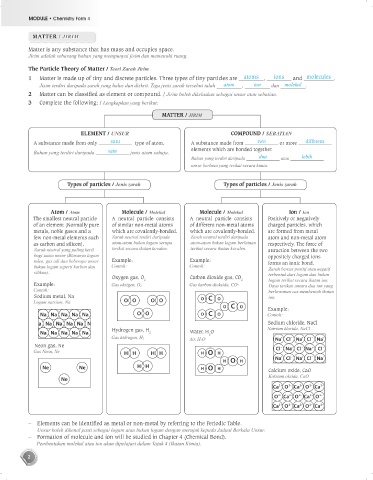
             1   Matter is made up of tiny and discrete particles. Three types of tiny particles are   atoms  ,   ions   and   molecules  .
                 Jisim terdiri daripada zarah yang halus dan diskrit. Tiga jenis zarah tersebut ialah   atom    ,   ion   dan  molekul .
             2   Matter can be classified as element or compound. / Jirim boleh dikelaskan sebagai unsur atau sebatian.
             3   Complete the following: / Lengkapkan yang berikut:
                                                           MATTER / JIRIM


                               ELEMENT / UNSUR                                    COMPOUND / SEBATIAN
               A substance made from only   satu    type of atom.   A substance made from   two    or more   different
               Bahan yang terdiri daripada   satu   jenis atom sahaja.  elements which are bonded together.
                                                                    Bahan yang terdiri daripada   dua   atau   lebih
                                                                    unsur berbeza yang terikat secara kimia.


                          Types of particles / Jenis zarah                     Types of particles / Jenis zarah


                     Atom / Atom             Molecule / Molekul        Molecule / Molekul             Ion / Ion
               The smallest neutral particle   A  neutral  particle  consists   A  neutral  particle  consists   Positively or negatively
               of an element (Normally pure   of similar non-metal atoms   of different non-metal atoms   charged particles, which
               metals, noble gases and a   which are covalently-bonded.  which are covalently-bonded.  are formed from metal
               few non-metal elements such   Zarah neutral terdiri daripada   Zarah neutral terdiri daripada   atom and non-metal atom
               as carbon and silicon).    atom-atom bukan logam serupa   atom-atom bukan logam berlainan   respectively. The force of
               Zarah neutral yang paling kecil   terikat secara ikatan kovalen.  terikat secara ikatan kovalen.  attraction between the two
               bagi suatu unsur (Biasanya logam                                                oppositely charged ions
               tulen, gas adi dan beberapa unsur   Example:         Example:                   forms an ionic bond.
               bukan logam seperti karbon dan   Contoh:             Contoh:                    Zarah bercas positif atau negatif
               silikon).                                                                       terbentuk dari logam dan bukan
                                          Oxygen gas, O 2           Carbon dioxide gas, CO 2
               Example:                  Gas oksigen, O2            Gas karbon dioksida, CO2   logam terikat secara ikatan ion.
                                                                                               Daya tarikan antara dua ion yang
               Contoh:                                                                         berlawanan cas membentuk ikatan
               Sodium metal, Na                                         O C  O                 ion.
               Logam natrium, Na              O O      O O
                                                                               O C   O         Example:
                 Na Na Na Na Na                   O O                   O C  O                Contoh:
               Na Na Na Na Na Na                                                               Sodium chloride, NaCl
                                          Hydrogen gas, H                                     Natrium klorida, NaCl
                 Na Na Na Na Na                       2             Water, H O
                                                                          2
                                         Gas hidrogen, H2           Air, H2O                     Na Cl –  Na Cl –  Na +
                                                                                                          +
                                                                                                   +
               Neon gas, Ne                                                                      Cl  –  Na Cl –  Na  +  Cl  –
                                                                                                       +
               Gas Neon, Ne                   H H      H H              H O  H
                                                                                                          +
                                                                                                   +
                                                                               H O   H              Na Cl –  Na Cl –  Na +
                  Ne          Ne                  H H                   H O  H                 Calcium oxide, CaO

                        Ne                                                                     Kalsium oksida, CaO
                                                                                                Ca 2+  O 2–  Ca 2+  O 2–  Ca 2+
                                                                                                 O  2–  Ca 2+  O  2–  Ca 2+  O  2–
                                                                                                Ca 2+  O 2–  Ca 2+  O  2–  Ca 2+

             –  Elements can be identified as metal or non-metal by referring to the Periodic Table.
                Unsur boleh dikenal pasti sebagai logam atau bukan logam dengan merujuk kepada Jadual Berkala Unsur.
             –  Formation of molecule and ion will be studied in Chapter 4 (Chemical Bond).
                Pembentukan molekul atau ion akan dipelajari dalam Tajuk 4 (Ikatan Kimia).

             2
           Nilam Publication Sdn. Bhd.

        01-Chem F4 (3p).indd   2                                                                                   12/9/2011   5:59:27 PM

