


Page 66 - Nilam_Publication_module_Chemistry_Form.pdf
P. 66
MODULE • Chemistry Form 4

                        –  The proton number   increases   by one unit from sodium to chlorine.
                        Nombor proton   bertambah   satu unit dari natrium kepada klorin.
                        –  Increase in proton number causes the number of   positive   charge in the nucleus to   increase  .
                        Pertambahan nombor proton menyebabkan bilangan cas   positif   pada nukleus   bertambah  .
                        –  The strength of attraction from the proton in the nucleus to the electrons in the shells   increases  .
                        Daya tarikan proton dalam nukleus terhadap elektron dalam petala   bertambah  .
                        –  The size of atom   decreases   across period 3 / Jejari atom unsur   berkurang   merentasi Kala 3.
                 (b)  Change in electronegativity / Perubahan keelektronegatifan:
                        –  Electronegativity: The strength of an atom in a molecule to attract   electron   towards its nucleus.
                        Kelektronegatifan: Kekuatan suatu atom dalam molekul menarik   elektron   ke arah nukleusnya.
                        –  The atomic radius   decreases   due to the   increasing   nuclei attraction on the electrons in the shells from
                        sodium to chlorine.
                        Jejari atom   berkurang   kerana daya tarikan nukleus terhadap elektron dalam petala   bertambah   dari natrium kepada
                        klorin.
                        –  The size of atom   decreases   from sodium to chlorine.
                        Saiz atom   berkurang   dari natrium kepada klorin.
                        –  Tendency of atoms to attract electron to the outermost shells   increases   from sodium to chlorine.
                        Kekuatan nukleus menarik elektron kepada petala paling luar   bertambah   dari natrium kepada klorin.
                        –  The electronegativity   increases   across Period 3 from sodium to chlorine.
                        Keelektonegatifan   bertambah   merentasi Kala 3 dari natrium kepada klorin.
                 (c)  Physical state / Keadaan fizik:
                     (i)   The physical state of elements in a period changes from solid to gas from left to right.
                         Keadaan fizik unsur-unsur dalam suatu kala berubah dari pepejal kepada gas dari kiri ke kanan.
                     (ii)  Metals on the left are solid while non-metals on the right are usually gases.
                         Logam di sebelah kiri adalah pepejal dan bukan logam di sebelah kanan kebanyakannya adalah gas.
                 (d)  Changes in metallic properties and electrical conductivity / Perubahan sifat kelogaman dan kekonduksian elektrik:
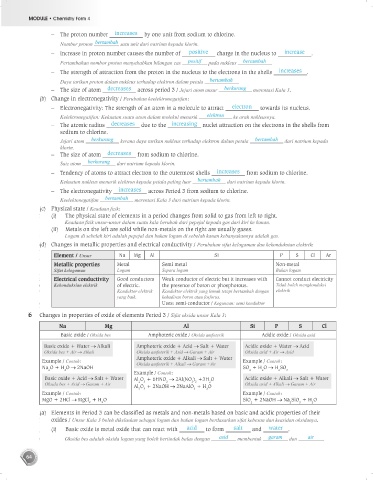
                      Element / Unsur       Na   Mg   Al                    Si                     P    S    Cl   Ar
                      Metallic properties  Metal           Semi metal                            Non-metal
                      Sifat kelogaman      Logam           Separa logam                          Bukan logam
                      Electrical conductivity  Good conductors   Weak conductor of electric but it increases with   Cannot conduct electricity
                      Kekonduksian elektrik  of electric.  the presence of boron or phosphorous.  Tidak boleh mengkonduksi
                                           Konduktor elektrik   Konduktor elektrik yang lemah tetapi bertambah dengan   elektrik
                                           yang baik.      kehadiran boron atau fosforus.
                                                           Uses: semi-conductor / Kegunaan: semi konduktor

             6   Changes in properties of oxide of elements Period 3 / Sifat oksida unsur Kala 3:
                        Na             Mg                         Al                     Si      P       S       Cl
                        Basic oxide / Oksida bes      Amphoteric oxide / Oksida amfoterik   Acidic oxide / Oksida asid
                  Basic oxide + Water   Alkali    Amphoteric oxide + Acid   Salt + Water  Acidic oxide + Water   Acid
                  Oksida bes + Air   Alkali       Oksida amfoterik + Asid   Garam + Air  Oksida asid + Air   Asid
                                                  Amphoteric oxide + Alkali   Salt + Water
                  Example / Contoh:                                                   Example / Contoh:
                  Na O + H O   2NaOH              Oksida amfoterik + Alkali   Garam +Air  SO  + H O   H SO
                    2    2                                                              2    2    2  3
                                                 Example / Contoh:
                   Basic oxide + Acid   Salt + Water  Al O  + 6HNO    2Al(NO )  +3H O  Acidic oxide + Alkali   Salt + Water
                                                   2
                                                                     3 3
                                                            3
                                                    3
                   Oksida bes + Asid   Garam + Air  Al O  + 2NaOH   2NaAlO  + H O 2    Oksida asid + Alkali   Garam + Air
                  Example / Contoh:                2  3              2    2           Example / Contoh:
                  MgO + 2HCl   MgCl  + H O                                            SiO  + 2NaOH   Na SiO  + H O
                                  2   2                                                  2            2  3    2
                 (a)  Elements in Period 3 can be classified as metals and non-metals based on basic and acidic properties of their
                     oxides / Unsur Kala 3 boleh dikelaskan sebagai logam dan bukan logam berdasarkan sifat kebesan dan keasidan oksidanya.
                     (i)   Basic oxide is metal oxide that can react with   acid   to form   salt   and   water  .
                         Oksida bes adalah oksida logam yang boleh bertindak balas dengan   asid   membentuk   garam   dan   air  .


            64
           Nilam Publication Sdn. Bhd.

        03-Chem F4 (3P).indd   64                                                                                  12/9/2011   5:57:55 PM

