


Page 68 - Nilam_Publication_module_Chemistry_Form.pdf
P. 68
MODULE • Chemistry Form 4

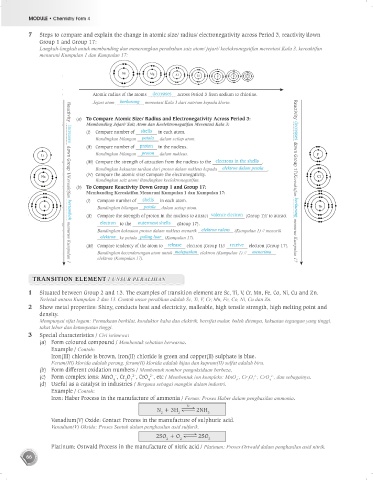
             7   Steps to compare and explain the change in atomic size/ radius/ electronegativity across Period 3, reactivity down
                 Group 1 and Group 17:
                 Langkah-langkah untuk membanding dan menerangkan perubahan saiz atom/ jejari/ keelekronegatifan merentasi Kala 3, kereaktifan
                 menuruni Kumpulan 1 dan Kumpulan 17:


                                                                                  16 p
                                   Atomic radius of the atoms   decreases   across Period 3 from sodium to chlorine.
                                   Jejari atom  berkurang  merentasi Kala 3 dari natrium kepada klorin.

                             (a)  To Compare Atomic Size/ Radius and Electronegativity Across Period 3:
                                 Membanding Jejari/ Saiz Atom dan Keelektronegatifan Merentasi Kala 3:
                          Reactivity
                                 (i)  Compare number of   shells   in each atom.
                                    Bandingkan bilangan   petala   dalam setiap atom.
                           increases
                                 (ii)  Compare number of  proton  in the nucleus.

                                    Bandingkan bilangan  proton  dalam nukleus.
                 Li                                                                                            F
                                 (iii)  Compare the strength of attraction from the nucleus to the  electrons in the shells .
                                    Bandingkan kekuatan tarikan dari proton dalam nukleus kepada  elektron dalam petala .
                                 (iv)  Compare the atomic size/ Compare the electronegativity.
                 Na                                                                                            Cl
                                    Bandingkan saiz atom/ Bandingkan keelektronegatifan.                Reactivity  decreases  down Group 17/Kereaktifan  berkurang  menurun Kumpulan 17
                             (b)  To Compare Reactivity Down Group 1 and Group 17:
                                 Membanding Kereaktifan Menuruni Kumpulan 1 dan Kumpulan 17:
                                 (i)   Compare number of   shells   in each atom.
                  K        down Group 1/Kereaktifan  bertambah  menurun Kumpulan 1  Bandingkan bilangan   petala   dalam setiap atom.  Br
                                 (ii)  Compare the strength of proton in the nucleus to attract  valence electron  (Group 1)// to attract
                                     electron  to the   outermost shells   (Group 17).
                                     Bandingkan kekuatan proton dalam nukleus menarik  elektron valens  (Kumpulan 1) // menarik
                                      elektron  ke petala  paling luar  (Kumpulan 17).
                                 (iii)  Compare tendency of the atom to  release  electron (Group 1)//  receive  electron (Group 17).
                                     Bandingkan kecenderungan atom untuk  melepaskan  elektron (Kumpulan 1) //   menerima
                                     elektron (Kumpulan 17).


              TRANSITION ELEMENT / UNSUR PERALIHAN

             1   Situated between Group 2 and 13. The examples of transition element are Sc, Ti, V, Cr, Mn, Fe, Co, Ni, Cu and Zn.
                 Terletak antara Kumpulan 2 dan 13. Contoh unsur peralihan adalah Sc, Ti, V, Cr, Mn, Fe, Co, Ni, Cu dan Zn.
             2   Show metal properties: Shiny, conducts heat and electricity, malleable, high tensile strength, high melting point and
                 density.
                 Mempunyai sifat logam: Permukaan berkilat, konduktor haba dan elektrik, bersifat mulur, boleh ditempa, kekuatan tegangan yang tinggi,
                 takat lebur dan ketumpatan tinggi.
             3   Special characteristics / Ciri istimewa:
                 (a)  Form coloured compound / Membentuk sebatian berwarna.
                     Example / Contoh:
                     Iron(III) chloride is brown, iron(II) chloride is green and copper(II) sulphate is blue.
                     Ferum(III) klorida adalah perang, ferum(II) klorida adalah hijau dan kuprum(II) sulfat adalah biru.
                 (b)  Form different oxidation numbers / Membentuk nombor pengoksidaan berbeza.
                 (c)  Form complex ions: MnO , Cr O , CrO , etc / Membentuk ion kompleks: MnO , Cr O , CrO , dan sebagainya.
                                                2–
                                           –
                                                      2–
                                                                                    –
                                                                                          2–
                                                                                                2–
                                                      4
                                                                                        2
                                                                                               4
                                                                                    4
                                                                                         7
                                          4
                                              2
                                                7
                 (d)  Useful as a catalyst in industries / Berguna sebagai mangkin dalam industri.
                     Example / Contoh:
                     Iron: Haber Process in the manufacture of ammonia / Ferum: Proses Haber dalam penghasilan ammonia.
                                                                   Fe
                                                         N  + 3H       2NH
                                                          2     2         3
                     Vanadium(V) Oxide: Contact Process in the manufacture of sulphuric acid.
                     Vanadium(V) Oksida: Proses Sentuh dalam penghasilan asid sulfurik.
                                                         2SO  + O      2SO
                                                            2    2        3
                     Platinum: Ostwald Process in the manufacture of nitric acid / Platinum: Proses Ostwald dalam penghasilan asid nitrik.
            66
           Nilam Publication Sdn. Bhd.
        03-Chem F4 (3P).indd   66                                                                                  12/9/2011   5:57:56 PM

