


Page 88 - Nilam_Publication_module_Chemistry_Form.pdf
P. 88
MODULE • Chemistry Form 4

                 (c)  The boiling point of substance V is 59°C. What is the physical state of substance V at room temperature?
                     Takat didih bahan V adalah 59°C. Apakah keadaan fizikal bahan V pada suhu bilik?
                     Liquid

                 (d)  Draw the arrangement of particle V at room temperature / Lukiskan susunan zarah V pada suhu bilik.


                 (e)  Explain why the melting and boiling points of substances V and W are low?
                     Jelaskan mengapa takat lebur dan takat didih bahan V dan W rendah?
                     – Van der Waals / intermolecular forces between molecules are weak.

                     – Small amount of heat energy is required to overcome it.
                 (f)  (i)   State the type of particle in substance X / Nyatakan jenis zarah dalam sebatian X.
                          Ion                                                                                                       .
                      (ii)  Explain why substance X cannot conduct electricity in solid but can conduct electricity in molten state.
                         Jelaskan  mengapa bahan X tidak boleh mengkonduksi elektrik dalam keadaan pepejal tetapi boleh mengkonduksi elektrik
                         dalam keadaan leburan.
                          Ions are not freely moving // ions are in a fixed position in solid state. Ion can move freely in molten state.


                                                Objective Questions / Soalan Objektif


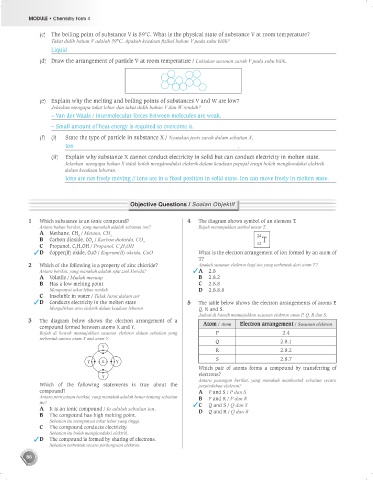
             1   Which substance is an ionic compound?             4   The diagram shows symbol of an element T.
                 Antara bahan berikut, yang manakah adalah sebatian ion?     Rajah menunjukkan simbol unsur T.
                 A  Methane, CH  / Metana, CH 4                                            24
                              4
                 B  Carbon dioxide, CO  / Karbon dioksida, CO 2                              T
                                   2
                 C  Propanol, C H OH / Propanol, C H OH                                    12
                                              7
                             3
                                            3
                               7
                 D  Copper(II) oxide, CuO / Kuprum(II) oksida, CuO      What is the electron arrangement of ion formed by an atom of
                                                                       T?
             2   Which of the following is a property of zinc chloride?     Apakah susunan elektron bagi ion yang terbentuk dari atom T?
                 Antara berikut, yang manakah adalah sifat zink klorida?   A  2.8
                 A  Volatile / Mudah meruap                            B  2.8.2
                 B  Has a low melting point                            C  2.8.8
                    Mempunyai takat lebur rendah                       D  2.8.8.8
                 C  Insoluble in water / Tidak larut dalam air
                 D  Conducts electricity in the molten state       5   The table below shows the electron arrangements of atoms P,
                    Mengalirkan arus elektrik dalam keadaan leburan    Q, R and S.
                                                                       Jadual di bawah menunjukkan susunan elektron atom P, Q, R dan S.
             3   The  diagram  below  shows  the  electron  arrangement  of  a
                 compound formed between atoms X and Y.                  Atom / Atom  Electron arrangement / Susunan elektron
                 Rajah  di  bawah  menunjukkan  susunan  elektron  dalam  sebatian  yang   P        2.4
                 terbentuk antara atom X and atom Y.
                                                                             Q                     2.8.1
                                      Y
                                                                             R                     2.8.2
                                                                             S                     2.8.7
                                 Y    X    Y
                                                                       Which  pair  of  atoms  forms  a  compound  by  transferring  of
                                      Y                                electrons?
                                                                       Antara  pasangan  berikut,  yang  manakah  membentuk  sebatian  secara
                 Which  of  the  following  statements  is  true  about  the   perpindahan elektron?
                 compound?                                             A  P and S / P dan S
                 Antara pernyataan berikut, yang manakah adalah benar tentang sebatian   B  P and R / P dan R
                 itu?                                                  C  Q and S / Q dan S
                 A  It is an ionic compound / Ia adalah sebatian ion.  D  Q and R / Q dan R
                 B  The compound has high melting point.
                    Sebatian itu mempunyai takat lebur yang tinggi.
                 C  The compound conducts electricity.
                    Sebatian itu boleh mengkonduksi elektrik.
                 D  The compound is formed by sharing of electrons.
                    Sebatian terbentuk secara perkongsian elektron.

            86
           Nilam Publication Sdn. Bhd.

        04-Chem F4 (3P).indd   86                                                                                  12/9/2011   5:57:12 PM

