


Page 36 - Human Environment Interface (3)
P. 36
Learning Intermittent Strategy

efficient than the continuous impedance control that was             EMG signals were fed into the DSP to obtain integrated
employed by the remaining small population of subjects.              electromyograms (iEMGs) of those muscles, which were further
                                                                     transformed into simulated antagonist muscle torques for actuat-
Methods                                                              ing the pendulum in real-time. Activations of TA and MG muscles
                                                                     generated the simulated muscle torques to pull the pendulum
2.1 Participants                                                     forward and backward, respectively, as in human standing.
   Eleven healthy male subjects with a mean age of 23 years          Subjects modulated their muscle activation levels by altering the
                                                                     tilt angle of their standing body. Subjects were instructed that no
(ranging from 21 and 25 years) participated in the experiment.       joint movements of upper and lower limbs, except the ankle joints,
None of the subjects had any research experiences in human           were allowed. Thus, modulation of the body tilt angle was
motor control. Experimental procedures of the study were in          achieved by dorsal and plantar flexions of the ankle joints,
accordance with the Declaration of Helsinki, and approved by the     inducing small voluntary body sway of subjects in the anterior-
Ethics Committee on Human Experiments at Graduate School of          posterior direction. It was expected that, when the pendulum tilted
Engineering Science, Osaka University. All subjects gave written     forward, subjects also tilted forward to increase the activation level
informed consent prior to their inclusion in the study.              of MG so that the pendulum could be pulled backward, whereas
                                                                     when the pendulum tilted backward, subjects also tilted backward
2.2 Outline of the experiments                                       to activate TA muscle so that the pendulum could be pulled
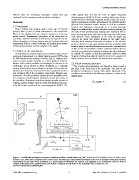
   Virtual balancing involved balancing a simulated single inverted  forward, implying that subjects might keep track of a sequence of
                                                                     falling motions of the pendulum for balancing the pendulum.
pendulum implemented in a digital signal processor (DSP) using
an EMG-based human-computer interface (Fig. 1). Subjects were        2.3 Virtual inverted pendulum
asked to stand upright normally on a force platform barefoot.           The virtual inverted pendulum was allowed to rotate around a
Motion of the virtual pendulum was displayed in real-time on an
oscilloscope screen located in front of subjects as a vertically     pin joint at the distal end of the pendulum. The joint of the
moving horizontal bar representing the tilt angle of the pendulum.   pendulum corresponds to human ankle joints. Dynamics of the
Upward and downward motions of the bar represented forward           pendulum was modeled by the following equation of motion in the
and backward tilts of the pendulum, respectively. Subjects were      sagittal plane.
instructed to keep the pendulum upright as much as possible under
the continuous visual feedback information about the motion of       I h€~mghhzT  ð1Þ
the pendulum. Activation levels of two antagonist ankle muscles of
subjects, namely, Tibialis Anterior (TA) and Medial Gastrocne-
mius (MG) were monitored by electromyography (EMG). The

Figure 1. An EMG-based human-computer interface used for virtual balancing. EMGs derived from TA and MG muscles of subjects were
fed into a DSP, which were transformed into active torques for balancing a virtual inverted pendulum in the DSP. A vertically moving horizontal bar
representing the tilt angle of the pendulum, as a visual feedback information for subjects, was displayed on an oscilloscope screen in front of
subjects. EMG signals, force-platform-based CoP motion of subjects and tilt angle of the pendulum were recorded by a PC.
doi:10.1371/journal.pone.0062956.g001

PLOS ONE | www.plosone.org                                           3 May 2013 | Volume 8 | Issue 5 | e62956

