


Page 37 - Human Environment Interface (4)
P. 37
Multi-Interface Domain Analysis

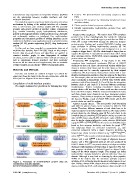
a domain have any cooperative or competitive relations. (iv) What       N Retrieve PPI (Protein-Protein Interaction) complexes from
are the associations between multiple interfaces and their
molecular functions?                                                        PDB;

   Our study thus aims to unveil some facets of protein interaction     N Preprocess PPI complexes by eliminating transformed chains
mechanisms by looking at the multiple interfaces of a domain.
This is new because past interface analysis [20–22] generally               and short chains;
provides only generic profiles of interface residue organization
(e.g., residues contacting graph, hydrophobicity distribution,          N Cluster protein chains by sequence similarity;
polarity scattering) and interface residue preference (e.g., favorable  N Identify representative multi-interface proteins from each
and unfavorable residues on interfaces). Our multi-interface
properties and the generic profiles of binding interfaces can be            protein cluster.
combined to facilitate many applications such as protein function
analysis [23–25], protein engineering [26,27], drug development           Retrieve PPI complexes. We retrieve those PDB complexes
[28,29].                                                                produced by X-Ray crystallography that satisfy the following
                                                                        criteria: (i) Their macromolecule type is protein but not DNA or
   To this end, we have compiled a representative data set of           RNA. We exclude DNA/RNA because the difference between
multi-interface domains from PDB [30]. Based on this compre-            protein-protein binding and protein-DNA/RNA binding may
hensive data set, graph theory and algorithms are applied to            cause confusion in defining multi-interface proteins. (ii) The
construct interface graph, to mine fingerprints of multiple             number of protein chains within each biological unit in one
interfaces, and to explore relations within multiple interfaces as      complex is bigger than 1. (iii) The chain length is larger than or
well as associations between interfaces and their molecular             equal to 30. (iv) Their X-ray resolution is better than 3.0 A˚ . Using
functions. All the data sets and supplementary files are available      these selection criteria, 35,760 PDB entries containing 109,672
at http://sunim1.sce.ntu.edu.sg/,s080011/metp/index.html.               protein chains are obtained.
Materials and Methods
                                                                          Preprocess PPI complexes. A few chains in the PDB
   Our data and method are outlined in Figure 3, in which the           complexes have transformed coordinates (458 out of 109,672
upper part shows the steps for the data set construction, while the     chains in our data set). Hence the structural relation within these
lower part is a diagram of our data analysis.                           chains or between these chains and the other chains in the same
Compilation of multi-interface proteins                                 complex may not be correctly represented by their original
                                                                        coordinates. We thus remove those protein chains with a non-
   We compile multi-interface proteins in the following four steps:     identity transformation matrix to clean the noise in the final data
                                                                        set. For example, there are two chains (A and B) with transformed
Figure 3. Flowchart of multi-interface protein data set                 atom coordinates in biomolecule 2 of PDB entry 3HZN, which
construction and data analysis.                                         contains a total of four chains (A, B, C and D); thus the interaction
doi:10.1371/journal.pone.0050821.g003                                   between chain A and chain D is incorrect without coordinates
                                                                        transformation. Besides excluding transformed chains, those
                                                                        protein chains with less than 30 amino acids are also removed
                                                                        from each PDB complex. With the removal of transformed chains
                                                                        and short chains, some chains do not have interaction partner
                                                                        anymore. These chains or complexes are further eliminated from
                                                                        the data set. Finally, a total of 24,664 PDB entries with 87,395
                                                                        protein chains are used for analysis.

                                                                          Cluster similar chains. The same protein chain interacting
                                                                        with different protein chains can be included in different PDB
                                                                        entries. Therefore, different instances of each chain have to be
                                                                        clustered together to identify multiple interfaces. We cluster similar
                                                                        protein chains by the following steps: (i) For each chain in the
                                                                        compiled data set containing 87,395 protein chains, we search the
                                                                        other 87,394 chains using BLAST [31] with e-value of 0.001, and
                                                                        store the similar chains satisfying the e-value criterion. (ii) We build
                                                                        a graph Gchain~SV chain,EchainT for the entire set of 87,395 chains
                                                                        based on their sequence similarity, and cluster the graph Gchain
                                                                        into subgroups based on connected components—i.e., each
                                                                        connected component forms a cluster. Sequence similarity Sij
                                                                        between two chains i and j is defined as Sij ~Niijdentical =Niajligned ,
                                                                        where Niijdentical is the number of identical aligned residues between
                                                                        chains i and j, and Niajligned is the length of alignment between
                                                                        chains i and j. The alignments used are the ones produced by
                                                                        BLAST. Nodes in Gchain are protein chains, and edges are similar
                                                                        chain-pairs with mutation rate lower than or equal to 2.5%. Pair-
                                                                        wise sequence similarity is calculated based on aligned length
                                                                        instead of the whole sequence length. This strategy can detect
                                                                        multi-interface domains included in proteins with more than one
                                                                        domain. Although it may lead to clustering by short peptides,
                                                                        99.4% of the clusters have the minimum pair-wise sequence
                                                                        similarity of 0.9, indicating that this situation rarely happens in our
                                                                        data. Besides, almost all the clusters have the minimum pair-wise
                                                                        sequence similarity of 0.9, confirming that our data is nearly free of

PLOS ONE | www.plosone.org                                              3 December 2012 | Volume 7 | Issue 12 | e50821

