


Page 23 - revista2019-final_Neat
P. 23
4.9  ceṉṟutēyntu iṟutal:
                   Many authors begin with much rigor and enthusiasm but get damped during the process. Such books
                   will show a gradient in its treatment of the subject beginning with rigor and dying out eventually.
                   Since the impact left by a book heavily depends on its end, a book incorporating this demerit will
                   obviously leave less or no impact!

                   4.10 niṉṟu payaṉiṉmai:
                   Any definition or chapter, or sometimes an entire book that has no useful contribution would fall
                   under this demerit. Every single word should have a purpose. So it is for a book. A good author will
                   always justify his writing the book, despite the existence of books in the same field.

                   5. Pattu Aḻaku – The Ten Merits
                   Essentially, the ten merits, every good book / article should incorporate, is the opposite of the ten
                   demerits listed above.

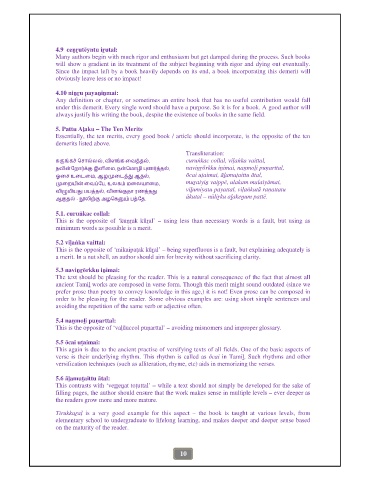
                                                               Transliteration:
                   23!க  ெசா ல , வ$ள!க ைவ த ,                  curuṅkac collal, viḷaṅka vaittal,
                   நவ$ ேறா    இன*ைம, ந ெமாழி  ண  த ,           naviṉṟōrkku iṉimai, naṉmoḻi puṇarttal,
                   ஓைச உைடைம, ஆழ7ைட   ஆத ,                     ōcai uṭaimai, āḻamuṭaittu ātal,
                   7ைறய$  ைவ8ேப, உலக. மைலயாைம,                 muṟaiyiṉ vaippē, ulakam malaiyāmai,
                   வ$9மிய  பய த , வ$ள! தா ரண த                 viḻumiyatu payattal, viḷaṅkutā raṇattatu
                                                               ākutal – nūliṟku aḻakeṉum pattē.
                   ஆ த  - /லி   அழெக;. ப ேத.


                   5.1. curuṅkac collal:
                   This  is  the  opposite  of  ‘kuṉṟak  kūṟal’  –  using  less  than  necessary  words  is  a  fault,  but  using  as
                   minimum words as possible is a merit.

                   5.2 viḷaṅka vaittal:
                   This is the opposite of ‘mikaipaṭak kūṟal’ – being superfluous is a fault, but explaining adequately is
                   a merit. In a nut shell, an author should aim for brevity without sacrificing clarity.

                   5.3 naviṉṟōrkku iṉimai:
                   The text should be pleasing for the reader. This is a natural consequence of the fact that almost all
                   ancient Tamiḻ works are composed in verse form. Though this merit might sound outdated (since we
                   prefer prose than poetry to convey knowledge in this age,) it is not! Even prose can be composed in
                   order to be pleasing for the reader. Some obvious examples are: using short simple sentences and
                   avoiding the repetition of the same verb or adjective often.

                   5.4 naṉmoḻi puṇarttal:
                   This is the opposite of ‘vaḻūuccol puṇarttal’ – avoiding misnomers and improper glossary.

                   5.5 ōcai uṭaimai:
                   This again is due to the ancient practise of versifying texts of all fields. One of the basic aspects of
                   verse is their underlying rhythm. This rhythm is called as ōcai in Tamiḻ. Such rhythms and other
                   versification techniques (such as alliteration, rhyme, etc) aids in memorizing the verses.

                   5.6 āḻamuṭaittu ātal:
                   This contrasts with ‘veṟṟeṉat toṭuttal’ – while a text should not simply be developed for the sake of
                   filling pages, the author should ensure that the work makes sense in multiple levels – ever deeper as
                   the readers grow more and more mature.

                   Tirukkuṟaḷ  is  a  very  good  example  for  this  aspect  –  the  book  is  taught  at  various  levels,  from
                   elementary school to undergraduate to lifelong learning, and makes deeper and deeper sense based
                   on the maturity of the reader.


                                                             10

