


Page 24 - revista2019-final_Neat
P. 24
5.7  muṟaiyiṉ vaippu:
                   This  is  proper  structuring.  Concepts  should  be  presented  in  some  logical  order.  A  build-up  of
                   knowledge and rigor should be ensured.

                   5.8  ulakam malaiyāmai:
                   This  refers  to  the  book  or  any  of  its  concept  not  contradicting  already  established  corpus  of
                   knowledge and traditions. Even if the author has something new or apparently out of the box idea /
                   hypothesis, it should be presented logically from existing first principles.

                   The  Correspondence  principle  postulated  by  Niels  Bohr  in  Quantum  Mechanics  is  similar  to  this
                   idea.

                   5.9  viḻumiyatu payattal:
                   This is in contrast with ‘niṉṟu payaṉiṉmai’ – the work should be of use and value in a given field.
                   Again, the author should at least justify himself / herself in writing that work that it will add to some
                   unique utility!

                   5.10  viḷaṅku utāraṇattatu ākutal:
                   This particular aspect is expressed as a iraṭṭuṟa moḻital (interpretable in two or many ways): a) The
                   text should contain adequate examples and b) The text itself should be a good example of its kind.

                   As  noted  earlier,  the  book  Naṉṉūl  itself  is  a  good  example  of  all  these  aspects  and  techniques
                   enumerated by it!

                   6. Some Illustrations

                   Let me illustrate some of the above aspects as seen in a couple of ancient Tamiḻ texts.
                   My first and favourite example is from the oldest extant Tamiḻ book – the Tolkāppiyam.

                   In this two thousand five hundred year old grammar, the author (Tolkāppiyar) sanctions the use of
                   Sanskrit (and other languages, such as Prakrit, Pali, etc) words in Tamiḻ and the process requires
                   substituting all letters that are not available in Tamiḻ, with corresponding Tamiḻ letters.

                   That is, the word ‘sarasvati’, for example, should be written in Tamiḻ as ‘caracuvati’, since Tamiḻ
                   lacks the ‘s’ sound. (Such modified words used in Tamiḻ are called as ‘tatcamam’, whereas words
                   made entirely of letters available in Tamiḻ itself are called as ‘tatpavam’ (lit. as it is)).
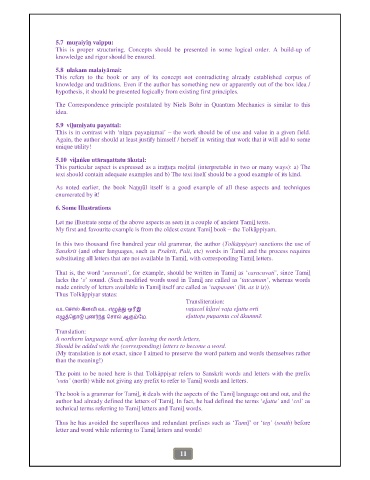
                   Thus Tolkāppiyar states:
                                                               Transliteration:
                   வடெசா  கிளவ$ வட எ9   ஒ=இ                    vaṭacol kiḷavi vaṭa eḻuttu orīi
                   எ9 ெதா#  ண (த ெசா  ஆ .ேம.                   eḻuttoṭu puṇarnta col ākummē.

                   Translation:
                   A northern language word, after leaving the north letters,
                   Should be added with the (corresponding) letters to become a word.
                   (My translation is not exact, since I aimed to preserve the word pattern and words themselves rather
                   than the meaning!)

                   The point to be noted here is that Tolkāppiyar refers to Sanskrit words and letters with the prefix
                   ‘vata’ (north) while not giving any prefix to refer to Tamiḻ words and letters.

                   The book is a grammar for Tamiḻ, it deals with the aspects of the Tamiḻ language out and out, and the
                   author had already defined the letters of Tamiḻ. In fact, he had defined the terms ‘eḻuttu’ and ‘col’ as
                   technical terms referring to Tamiḻ letters and Tamiḻ words.

                   Thus he has avoided the superfluous and redundant prefixes such as ‘Tamiḻ’ or ‘teṉ’ (south) before
                   letter and word while referring to Tamiḻ letters and words!


                                                             11

