


Page 25 - revista2019-final_Neat
P. 25
The amount of precision and brevity  that is incorporated in to this one book, the way the author
                   develops a  meta-language  out  of  the  very  language  he  is  trying  to  define  and  deal  with,  without
                   sacrificing clarity or giving space for ambiguity, always blows my mind!

                   Another profound example is found in Tirukkuṟaḷ. Though the entire work or any random couplet
                   from it can be quoted, I would like to once again take a personal favourite of mine.

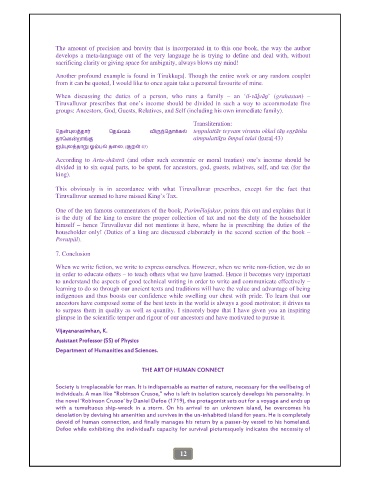
                   When  discussing  the  duties  of  a  person,  who  runs  a  family  –  an  ‘il-vāḻvāṉ’  (grahastan)  –
                   Tiruvalluvar  prescribes  that  one’s  income  should be  divided  in  such  a  way  to  accommodate  five
                   groups: Ancestors, God, Guests, Relatives, and Self (including his own immediate family).

                                                                 Transliteration:
                   ெத  ல தா          ெத'வ.         வ$3(ெதா க   teṉpulattār teyvam viruntu okkal tāṉ eṉṟāṅku
                   தாென றா!                                      aimpulattāṟu ōmpal talai (kuraḷ 43)

                   ஐ. ல தா  ஓ.ப  தைல. ( ற? 43)

                   According  to  Arta-shāstrā  (and  other  such  economic  or  moral  treaties)  one’s  income  should  be
                   divided in to six equal parts, to be spent, for ancestors, god, guests, relatives, self, and tax (for the
                   king).

                   This  obviously  is  in  accordance  with  what  Tiruvalluvar  prescribes,  except  for  the  fact  that
                   Tiruvalluvar seemed to have missed King’s Tax.

                   One of the ten famous commentators of the book, Parimēlaḻakar, points this out and explains that it
                   is the duty of the king to ensure the proper collection of tax and not the duty of the householder
                   himself  –  hence  Tiruvalluvar  did  not  mentions  it  here,  where  he  is  prescribing  the  duties  of  the
                   householder only! (Duties of a king are discussed elaborately in the second section of the book –
                   Porutpāl).

                   7. Conclusion

                   When we write fiction, we write to express ourselves. However, when we write non-fiction, we do so
                   in order to educate others – to teach others what we have learned. Hence it becomes very important
                   to understand the aspects of good technical writing in order to write and communicate effectively –
                   learning to do so through our ancient texts and traditions will have the value and advantage of being
                   indigenous and thus boosts our confidence while swelling our chest with pride. To learn that our
                   ancestors have composed some of the best texts in the world is always a good motivator; it drives us
                   to surpass them in quality as well as quantity. I sincerely hope that I have given you an inspiring
                   glimpse in the scientific temper and rigour of our ancestors and have motivated to pursue it.

                    Vijayanarasimhan, K.ijayanarasimhan, K.
                   V
                   Vijayanarasimhan, K.Vijayanarasimhan, K.
                   A
                   Assistant Professor (SS) of PhysicsAssistant Professor (SS) of Physics
                    Assistant Professor (SS) of Physicsssistant Professor (SS) of Physics
                    Department of Humanities and Sciences.epartment of Humanities and Sciences.
                   D
                   Department of Humanities and Sciences.Department of Humanities and Sciences.

                                                T
                                                THE ART OF HUMAN CONNECTHE ART OF HUMAN CONNECT
                                                THE ART OF HUMAN CONNECTTHE ART OF HUMAN CONNECT

                   Society is irreplaceable for man. It is indispensable as matter of nature, necessary for the wellbeing of
                   individuals. A man like “Robinson Crusoe,” who is left in isolation scarcely develops his personality. In
                   the novel ‘Robinson Crusoe’ by Daniel Defoe (1719), the protagonist sets out for a voyage and ends up
                   with  a  tumultuous  ship-wreck  in  a  storm.  On  his  arrival  to  an  unknown  island,  he  overcomes  his
                   desolation by devising his amenities and survives in the un-inhabited island for years. He is completely
                   devoid of human connection, and finally manages his return by a passer-by vessel to his homeland.
                   Defoe while exhibiting the individual’s capacity for survival picturesquely indicates the necessity of


                                                             12

