


Page 29 - revista2019-final_Neat
P. 29
NECESSITY FOR ECESSITY FOR REDEFINING THE KILOGRAM:REDEFINING THE KILOGRAM:
                   N
                   NECESSITY FOR NECESSITY FOR REDEFINING THE KILOGRAM:REDEFINING THE KILOGRAM:

                   With  the  prototype of  Kilogram  showing  variation  in its  mass,  it  becomes  difficult  to measure  the
                   masses of tiny particles in many applications like the mass of fuel injected in an IC Engine per stroke,
                   chemical industries etc.

                   A Kibble (or watt) balance is an electromechanical measuring tool that measures the weight of an item
                   by the power of the electric current and voltage necessary to make a compensating force.

                   Defining  fundamental  units  based  on  universal  constants  has  a  lot  of  advantages  with  regards  to
                   scientific and industrial usage.

                    M.Amaranath.Amaranath
                   M
                   M.AmaranathM.Amaranath
                   Second Year / Mechanical Engineering

                                                      STIFFING CANCERTIFFING CANCER
                                                      STIFFING CANCERSTIFFING CANCER
                                                      S


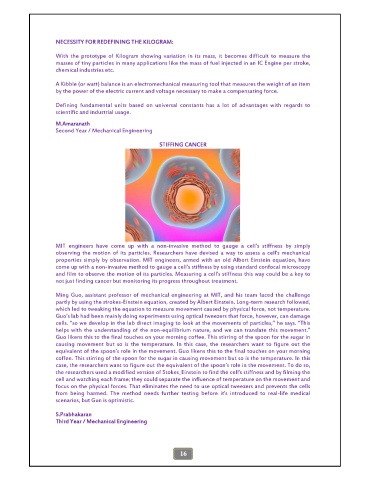
                   MIT  engineers  have  come  up  with  a  non-invasive  method  to  gauge  a  cell’s  stiffness  by  simply
                   observing the motion of its particles. Researchers have devised a way to assess  a cell’s mechanical
                   properties simply by observation. MIT engineers, armed with an old Albert Einstein equation, have
                   come up with a non-invasive method to gauge a cell’s stiffness by using standard confocal microscopy
                   and film to observe the motion of its particles. Measuring a cell’s stiffness this way could be a key to
                   not just finding cancer but monitoring its progress throughout treatment.

                   Ming Guo, assistant professor of mechanical engineering at MIT, and his team faced the challenge
                   partly by using the strokes-Einstein equation, created by Albert Einstein. Long-term research followed,
                   which led to tweaking the equation to measure movement caused by physical force, not temperature.
                   Guo’s lab had been mainly doing experiments using optical tweezers that force, however, can damage
                   cells. “so we develop in the lab direct imaging to look at the movements of particles,” he says. “This
                   helps with the understanding of the non-equilibrium nature, and we can translate this movement.”
                   Guo likens this to the final touches on your morning coffee. This stirring of the spoon for the sugar in
                   causing  movement  but  so  is  the  temperature.  In  this  case,  the  researchers  want  to  figure  out  the
                   equivalent of the spoon’s role in the movement. Guo likens this to the final touches on your morning
                   coffee. This stirring of the spoon for the sugar in causing movement but so is the temperature. In this
                   case, the researchers want to figure out the equivalent of the spoon’s role in the movement. To do so,
                   the researchers used a modified version of Stokes_Einstein to find the cell’s stiffness and by filming the
                   cell and watching each frame; they could separate the influence of temperature on the movement and
                   focus on the physical forces. That eliminates the need to use optical tweezers and prevents the cells
                   from  being  harmed.  The  method  needs  further  testing  before  it’s  introduced  to  real-life  medical
                   scenarios, but Gun is optimistic.

                    S. S. S. S.P PP Prabhakaranrabhakaran
                      rabhakaranrabhakaran
                   Third YearThird Year  / M/ Mechanical Engineeringechanical Engineering
                   T Third Yearhird Year  / M/ Mechanical Engineeringechanical Engineering


                                                             16

