


Page 11 - REC :: B.E. EEE Curriculum and Syllabus - R2019
P. 11
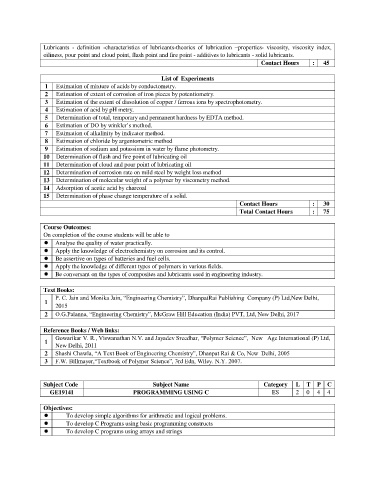
Lubricants - definition -characteristics of lubricants-theories of lubrication –properties- viscosity, viscosity index,
oiliness, pour point and cloud point, flash point and fire point - additives to lubricants - solid lubricants.
Contact Hours : 45
List of Experiments
1 Estimation of mixture of acids by conductometry.
2 Estimation of extent of corrosion of iron pieces by potentiometry.
3 Estimation of the extent of dissolution of copper / ferrous ions by spectrophotometry.
4 Estimation of acid by pH metry.
5 Determination of total, temporary and permanent hardness by EDTA method.
6 Estimation of DO by winkler’s method.
7 Estimation of alkalinity by indicator method.
8 Estimation of chloride by argentometric method
9 Estimation of sodium and potassium in water by flame photometry.
10 Determination of flash and fire point of lubricating oil
11 Determination of cloud and pour point of lubricating oil
12 Determination of corrosion rate on mild steel by weight loss method
13 Determination of molecular weight of a polymer by viscometry method.
14 Adsorption of acetic acid by charcoal
15 Determination of phase change temperature of a solid.
Contact Hours : 30
Total Contact Hours : 75
Course Outcomes:
On completion of the course students will be able to
Analyse the quality of water practically.
Apply the knowledge of electrochemistry on corrosion and its control.
Be assertive on types of batteries and fuel cells.
Apply the knowledge of different types of polymers in various fields.
Be conversant on the types of composites and lubricants used in engineering industry.
Text Books:
P. C. Jain and Monika Jain, “Engineering Chemistry”, DhanpatRai Publishing Company (P) Ltd,New Delhi,
1
2015
2 O.G.Palanna, “Engineering Chemistry”, McGraw Hill Education (India) PVT, Ltd, New Delhi, 2017
Reference Books / Web links:
Gowarikar V. R., Viswanathan N.V. and Jayadev Sreedhar, “Polymer Science”, New Age International (P) Ltd,
1
New Delhi, 2011
2 Shashi Chawla, “A Text Book of Engineering Chemistry”, Dhanpat Rai & Co, New Delhi, 2005
3 F.W. Billmayer,“Textbook of Polymer Science”, 3rd Edn, Wiley. N.Y. 2007.
Subject Code Subject Name Category L T P C
GE19141 PROGRAMMING USING C ES 2 0 4 4
Objectives:
To develop simple algorithms for arithmetic and logical problems.
To develop C Programs using basic programming constructs
To develop C programs using arrays and strings

