


Page 14 - REC :: B.E. EEE Curriculum and Syllabus - R2019
P. 14
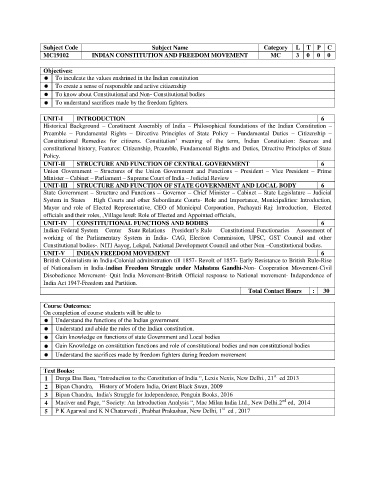
Subject Code Subject Name Category L T P C
MC19102 INDIAN CONSTITUTION AND FREEDOM MOVEMENT MC 3 0 0 0
Objectives:
To inculcate the values enshrined in the Indian constitution
To create a sense of responsible and active citizenship
To know about Constitutional and Non- Constitutional bodies
To understand sacrifices made by the freedom fighters.
UNIT-I INTRODUCTION 6
Historical Background – Constituent Assembly of India – Philosophical foundations of the Indian Constitution –
Preamble – Fundamental Rights – Directive Principles of State Policy – Fundamental Duties – Citizenship –
Constitutional Remedies for citizens. Constitution’ meaning of the term, Indian Constitution: Sources and
constitutional history, Features: Citizenship, Preamble, Fundamental Rights and Duties, Directive Principles of State
Policy.
UNIT-II STRUCTURE AND FUNCTION OF CENTRAL GOVERNMENT 6
Union Government – Structures of the Union Government and Functions – President – Vice President – Prime
Minister – Cabinet – Parliament – Supreme Court of India – Judicial Review
UNIT-III STRUCTURE AND FUNCTION OF STATE GOVERNMENT AND LOCAL BODY 6
State Government – Structure and Functions – Governor – Chief Minister – Cabinet – State Legislature – Judicial
System in States – High Courts and other Subordinate Courts- Role and Importance, Municipalities: Introduction,
Mayor and role of Elected Representative, CEO of Municipal Corporation, Pachayati Raj: Introduction, Elected
officials and their roles, ,Village level: Role of Elected and Appointed officials,
UNIT-IV CONSTITUTIONAL FUNCTIONS AND BODIES 6
Indian Federal System – Center – State Relations – President’s Rule – Constitutional Functionaries – Assessment of
working of the Parliamentary System in India- CAG, Election Commission, UPSC, GST Council and other
Constitutional bodies-. NITI Aayog, Lokpal, National Development Council and other Non –Constitutional bodies.
UNIT-V INDIAN FREEDOM MOVEMENT 6
British Colonialism in India-Colonial administration till 1857- Revolt of 1857- Early Resistance to British Rule-Rise
of Nationalism in India-Indian Freedom Struggle under Mahatma Gandhi-Non- Cooperation Movement-Civil
Disobedience Movement- Quit India Movement-British Official response to National movement- Independence of
India Act 1947-Freedom and Partition.
Total Contact Hours : 30
Course Outcomes:
On completion of course students will be able to
Understand the functions of the Indian government
Understand and abide the rules of the Indian constitution.
Gain knowledge on functions of state Government and Local bodies
Gain Knowledge on constitution functions and role of constitutional bodies and non constitutional bodies
Understand the sacrifices made by freedom fighters during freedom movement
Text Books:
st
1 Durga Das Basu, “Introduction to the Constitution of India “, Lexis Nexis, New Delhi., 21 ed 2013
2 Bipan Chandra, History of Modern India, Orient Black Swan, 2009
3 Bipan Chandra, India's Struggle for Independence, Penguin Books, 2016
nd
4 Maciver and Page, “ Society: An Introduction Analysis “, Mac Milan India Ltd., New Delhi.2 ed, 2014
st
5 P K Agarwal and K N Chaturvedi , Prabhat Prakashan, New Delhi, 1 ed , 2017

