


Page 71 - REC :: MBA CURRICULUM AND SYLLABUS :: R2019
P. 71
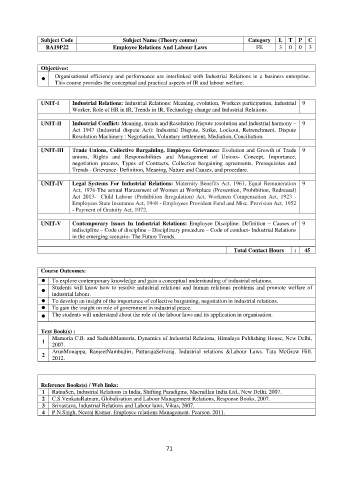
Subject Code Subject Name (Theory course) Category L T P C
BA19P22 Employee Relations And Labour Laws FE 3 0 0 3
Objectives:
Organisational efficiency and performance are interlinked with Industrial Relations in a business enterprise.
This course provides the conceptual and practical aspects of IR and labour welfare.
UNIT-I Industrial Relations: Industrial Relations: Meaning, evolution, Workers participation, Industrial 9
Worker, Role of HR in IR, Trends in IR, Technology change and Industrial Relations.
UNIT-II Industrial Conflict: Meaning, trends and Resolution Dispute resolution and Industrial harmony – 9
Act 1947 (Industrial dispute Act): Industrial Dispute, Strike, Lockout, Retrenchment, Dispute
Resolution Machinery : Negotiation, Voluntary settlement, Mediation, Conciliation.
UNIT-III Trade Unions, Collective Bargaining, Employee Grievance: Evolution and Growth of Trade 9
unions, Rights and Responsibilities and Management of Unions- Concept, Importance,
negotiation process, Types of Contracts, Collective bargaining agreements, Prerequisites and
Trends - Grievance- Definition, Meaning, Nature and Causes, and procedure.
UNIT-IV Legal Systems For Industrial Relations: Maternity Benefits Act, 1961, Equal Remuneration 9
Act, 1976-The sexual Harassment of Women at Workplace (Prevention, Prohibition, Redressal)
Act 2013- Child Labour (Prohibition ®ulation) Act, Workmen Compensation Act, 1923 -
Employees State Insurance Act, 1948 - Employees Provident Fund and Misc. Provision Act, 1952
- Payment of Gratuity Act, 1972.
UNIT-V Contemporary Issues In Industrial Relations: Employee Discipline: Definition – Causes of 9
indiscipline – Code of discipline – Disciplinary procedure – Code of conduct- Industrial Relations
in the emerging scenario- The Future Trends.
Total Contact Hours : 45
Course Outcomes:
To explore contemporary knowledge and gain a conceptual understanding of industrial relations.
Students will know how to resolve industrial relations and human relations problems and promote welfare of
industrial labour.
To develop an insight of the importance of collective bargaining, negotiation in industrial relations.
To gain the insight on role of government in industrial peace.
The students will understand about the role of the labour laws and its application in organisation.
Text Book(s) :
Mamoria C.B. and SathishMamoria, Dynamics of Industrial Relations, Himalaya Publishing House, New Delhi,
1
2007.
ArunMonappa, RanjeetNambudiri, PatturajaSelvaraj. Industrial relations &Labour Laws. Tata McGraw Hill.
2
2012.
Reference Books(s) / Web links:
1 RatnaSen, Industrial Relations in India, Shifting Paradigms, Macmillan India Ltd., New Delhi, 2007.
2 C.S.VenkataRatnam, Globalisation and Labour Management Relations, Response Books, 2007.
3 Srivastava, Industrial Relations and Labour laws, Vikas, 2007.
4 P.N.Singh, Neeraj Kumar. Employee relations Management. Pearson. 2011.
71

