


Page 73 - REC :: MBA CURRICULUM AND SYLLABUS :: R2019
P. 73
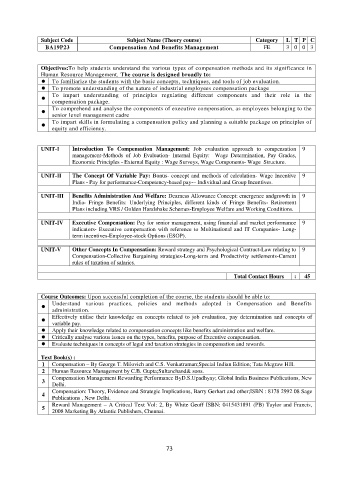
Subject Code Subject Name (Theory course) Category L T P C
BA19P23 Compensation And Benefits Management FE 3 0 0 3
Objectives:To help students understand the various types of compensation methods and its significance in
Human Resource Management. The course is designed broadly to:
To familiarize the students with the basic concepts, techniques, and tools of job evaluation.
To promote understanding of the nature of industrial employees compensation package
To impart understanding of principles regulating different components and their role in the
compensation package.
To comprehend and analyse the components of executive compensation, as employees belonging to the
senior level management cadre
To impart skills in formulating a compensation policy and planning a suitable package on principles of
equity and efficiency.
UNIT-I Introduction To Compensation Management: Job evaluation approach to compensation 9
management-Methods of Job Evaluation- Internal Equity: Wage Determination, Pay Grades,
Economic Principles - External Equity : Wage Surveys, Wage Components- Wage Structure.
UNIT-II The Concept Of Variable Pay: Bonus- concept and methods of calculation- Wage Incentive 9
Plans - Pay for performance-Competency-based pay-– Individual and Group Incentives.
UNIT-III Benefits Administration And Welfare: Dearness Allowance Concept: emergence andgrowth in 9
India- Fringe Benefits: Underlying Principles, different kinds of Fringe Benefits- Retirement
Plans including VRS / Golden Handshake Schemes-Employee Welfare and Working Conditions.
UNIT-IV Executive Compensation: Pay for senior management, using financial and market performance 9
indicators- Executive compensation with reference to Multinational and IT Companies- Long-
term incentives-Employee-stock Options (ESOP).
UNIT-V Other Concepts In Compensation: Reward strategy and Psychological Contract-Law relating to 9
Compensation-Collective Bargaining strategies-Long-term and Productivity settlements-Current
rules of taxation of salaries.
Total Contact Hours : 45
Course Outcomes: Upon successful completion of the course, the students should be able to:
Understand various practices, policies and methods adopted in Compensation and Benefits
administration.
Effectively utilise their knowledge on concepts related to job evaluation, pay determination and concepts of
variable pay.
Apply their knowledge related to compensation concepts like benefits administration and welfare.
Critically analyse various issues on the types, benefits, purpose of Executive compensation.
Evaluate techniques in concepts of legal and taxation strategies in compensation and rewards.
Text Book(s) :
1 Compensation – By George T. Milovich and C.S. Venkatraman;Special Indian Edition; Tata Mcgraw Hill.
2 Human Resource Management by C.B. Gupta;Sultanchand& sons.
Compensation Management Rewarding Performance ByD.S.Upadhyay; Global India Business Publications, New
3
Delhi.
Compensation: Theory, Evidence and Strategic Implications, Barry Gerhart and other;ISBN : 8178 2992 08 Sage
4
Publications , New Delhi.
Reward Management – A Critical Text Vol: 2, By White Geoff ISBN: 0415431891 (PB) Taylor and Francis,
5
2008 Marketing By Atlantic Publishers, Chennai.
73

