


Page 20 - REC :: M.E. CSE Curriculum and Syllabus - R2019
P. 20
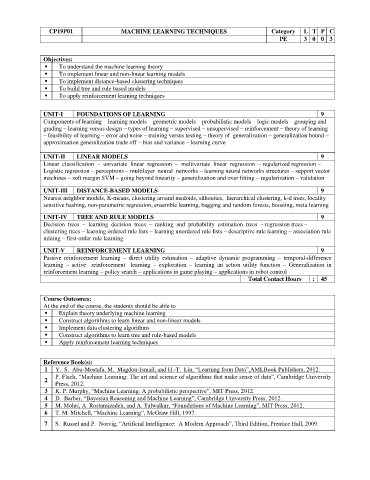
CP19P01                 MACHINE LEARNING TECHNIQUES                       Category   L  T  P  C
                                                                                              PE      3  0  0  3


               Objectives:
                ⚫    To understand the machine learning theory
                ⚫    To implement linear and non-linear learning models
                ⚫    To implement distance-based clustering techniques
                ⚫    To build tree and rule based models
                ⚫    To apply reinforcement learning techniques


               UNIT-I     FOUNDATIONS OF LEARNING                                                          9
               Components of learning – learning models – geometric models – probabilistic models – logic models – grouping and
               grading – learning versus design – types of learning – supervised – unsupervised – reinforcement – theory of learning
               – feasibility of learning – error and noise – training versus testing – theory of  generalization – generalization bound –
               approximation generalization trade off – bias and variance – learning curve

               UNIT-II    LINEAR MODELS                                                                    9
               Linear  classification  –  univariate  linear  regression  –  multivariate  linear  regression  – regularized regression –
               Logistic regression – perceptrons – multilayer  neural  networks – learning neural networks structures – support vector
               machines – soft margin SVM – going beyond linearity – generalization and over fitting – regularization – validation

               UNIT-III   DISTANCE-BASED MODELS                                                            9
               Nearest neighbor models, K-means, clustering around medoids, silhouttes,  hierarchical clustering, k-d trees, locality
               sensitive hashing, non-parametric regression, ensemble learning, bagging and random forests, boosting, meta learning

               UNIT-IV    TREE AND RULE MODELS                                                             9
               Decision  trees  –  learning  decision  trees  –  ranking  and  probability  estimation  trees  – regression trees –
               clustering trees – learning ordered rule lists – learning unordered rule lists – descriptive rule learning – association rule
               mining – first-order rule learning

               UNIT-V     REINFORCEMENT LEARNING                                                           9
               Passive  reinforcement  learning  –  direct  utility  estimation  –  adaptive  dynamic  programming  –  temporal-difference
               learning  –  active    reinforcement    learning  –  exploration  –  learning  an  action  utility  function  –  Generalization  in
               reinforcement learning – policy search – applications in game playing – applications in robot control
                                                                                   Total Contact Hours   :  45


               Course Outcomes:
               At the end of the course, the students should be able to
                ⚫    Explain theory underlying machine learning
                     Construct algorithms to learn linear and non-linear models
                ⚫
                     Implement data clustering algorithms
                ⚫
                     Construct algorithms to learn tree and rule-based models
                ⚫
                     Apply reinforcement learning techniques
                ⚫

               Reference Book(s):
                1   Y.  S.  Abu-Mostafa, M.  Magdon-Ismail, and H.-T.  Lin, “Learning from Data”,AMLBook Publishers, 2012.
                   P. Flach, “Machine Learning: The art and science of algorithms that make sense of data”, Cambridge University
                2
                   Press, 2012.
                3   K. P. Murphy, “Machine Learning: A probabilistic perspective”, MIT Press, 2012.
                4   D.  Barber, “Bayesian Reasoning and Machine Learning”, Cambridge University Press, 2012.
                5   M. Mohri, A. Rostamizadeh, and A. Talwalkar, “Foundations of Machine Learning”, MIT Press, 2012.
                6   T. M. Mitchell, “Machine Learning”, McGraw Hill, 1997.

                7   S.  Russel and P.  Norvig, “Artificial Intelligence:  A Modern Approach”, Third Edition, Prentice Hall, 2009.

