


Page 21 - REC :: M.E. CSE Curriculum and Syllabus - R2019
P. 21
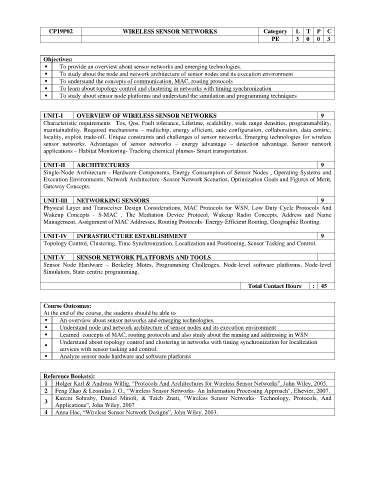
CP19P02                  WIRELESS SENSOR NETWORKS                      Category   L  T  P  C
                                                                                           PE      3   0   0  3


               Objectives:
                ⚫    To provide an overview about sensor networks and emerging technologies.
                ⚫    To study about the node and network architecture of sensor nodes and its execution environment
                ⚫    To understand the concepts of communication, MAC, routing protocols
                ⚫    To learn about topology control and clustering in networks with timing synchronization
                ⚫    To study about sensor node platforms and understand the simulation and programming techniques


               UNIT-I     OVERVIEW OF WIRELESS SENSOR NETWORKS                                             9
               Characteristic requirements –Tos, Qos, Fault tolerance, Lifetime, scalability, wide range densities, programmability,
               maintainability. Required mechanisms  – multichip, energy efficient, auto configuration, collaboration, data centric,
               locality, exploit trade-off. Unique constraints and challenges of sensor networks. Emerging technologies for wireless
               sensor  networks.  Advantages  of  sensor  networks  –  energy  advantage  –  detection  advantage.  Sensor  network
               applications – Habitat Monitoring- Tracking chemical plumes- Smart transportation.

               UNIT-II    ARCHITECTURES                                                                    9
               Single-Node Architecture - Hardware Components, Energy Consumption of Sensor Nodes , Operating Systems and
               Execution Environments, Network Architecture -Sensor Network Scenarios, Optimization Goals and Figures of Merit,
               Gateway Concepts.

               UNIT-III   NETWORKING SENSORS                                                               9
               Physical Layer and Transceiver Design Considerations, MAC Protocols for WSN, Low Duty Cycle Protocols And
               Wakeup  Concepts  -  S-MAC  ,  The  Mediation  Device  Protocol,  Wakeup  Radio  Concepts,  Address  and  Name
               Management, Assignment of MAC Addresses, Routing Protocols- Energy-Efficient Routing, Geographic Routing.

               UNIT-IV    INFRASTRUCTURE ESTABLISHMENT                                                     9
               Topology Control, Clustering, Time Synchronization, Localization and Positioning, Sensor Tasking and Control.

               UNIT-V     SENSOR NETWORK PLATFORMS AND TOOLS
               Sensor  Node  Hardware  –  Berkeley  Motes,  Programming  Challenges,  Node-level  software  platforms,  Node-level
               Simulators, State-centric programming.

                                                                                   Total Contact Hours   :  45

               Course Outcomes:
               At the end of the course, the students should be able to
                ⚫    An overview about sensor networks and emerging technologies.
                ⚫    Understand node and network architecture of sensor nodes and its execution environment
                ⚫    Learned  concepts of MAC, routing protocols and also study about the naming and addressing in WSN
                     Understand about topology control and clustering in networks with timing synchronization for localization
                ⚫
                     services with sensor tasking and control.
                ⚫    Analyze sensor node hardware and software platforms


               Reference Books(s):
                1   Holger Karl & Andreas Willig, “Protocols And Architectures for Wireless Sensor Networks”, John Wiley, 2005.
                2   Feng Zhao & Leonidas J. G., “Wireless Sensor Networks- An Information Processing Approach", Elsevier, 2007.
                   Kazem  Sohraby,  Daniel  Minoli,  &  Taieb  Znati,  “Wireless  Sensor  Networks-  Technology,  Protocols,  And
                3
                   Applications”, John Wiley, 2007
                4   Anna Hac, “Wireless Sensor Network Designs”, John Wiley, 2003.

