


Page 23 - REC :: M.E. CSE Curriculum and Syllabus - R2019
P. 23
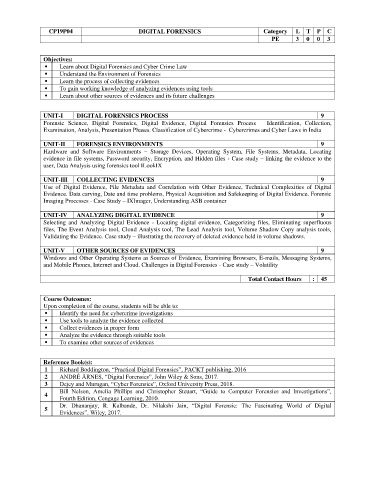
CP19P04                       DIGITAL FORENSICS                        Category   L  T  P  C
                                                                                           PE      3   0   0  3


               Objectives:
                ⚫    Learn about Digital Forensics and Cyber Crime Law
                ⚫    Understand the Environment of Forensics
                ⚫    Learn the process of collecting evidences
                ⚫    To gain working knowledge of analyzing evidences using tools
                ⚫    Learn about other sources of evidences and its future challenges


               UNIT-I     DIGITAL FORENSICS PROCESS                                                        9
               Forensic  Science,  Digital  Forensics,  Digital  Evidence,  Digital  Forensics  Process  –  Identification,  Collection,
               Examination, Analysis, Presentation Phases. Classification of Cybercrime -  Cybercrimes and Cyber Laws in India

               UNIT-II    FORENSICS ENVIRONMENTS                                                           9
               Hardware  and  Software  Environments  –  Storage  Devices,  Operating  System,  File  Systems,  Metadata,  Locating
               evidence in file systems, Password security, Encryption, and Hidden files - Case study – linking the evidence to the
               user, Data Analysis using forensics tool ILookIX

               UNIT-III   COLLECTING EVIDENCES                                                             9
               Use  of  Digital  Evidence,  File  Metadata  and  Correlation  with  Other  Evidence,  Technical  Complexities  of  Digital
               Evidence. Data carving, Date and time problems, Physical Acquisition and Safekeeping of Digital Evidence. Forensic
               Imaging Processes - Case Study – IXImager, Understanding.ASB container

               UNIT-IV    ANALYZING DIGITAL EVIDENCE                                                       9
               Selecting  and  Analyzing  Digital  Evidence  -  Locating  digital  evidence,  Categorizing  files,  Eliminating  superfluous
               files, The Event Analysis tool, Cloud Analysis tool, The Lead Analysis tool, Volume Shadow Copy analysis tools,
               Validating the Evidence. Case study – illustrating the recovery of deleted evidence held in volume shadows.

               UNIT-V     OTHER SOURCES OF EVIDENCES                                                       9
               Windows and Other Operating Systems as Sources of Evidence, Examining Browsers, E-mails, Messaging Systems,
               and Mobile Phones, Internet and Cloud. Challenges in Digital Forensics - Case study – Volatility

                                                                                   Total Contact Hours   :  45


               Course Outcomes:
               Upon completion of the course, students will be able to:
                ⚫    Identify the need for cybercrime investigations
                ⚫    Use tools to analyze the evidence collected
                ⚫    Collect evidences in proper form
                ⚫    Analyze the evidence through suitable tools
                ⚫    To examine other sources of evidences


               Reference Book(s):
                1    Richard Boddington, “Practical Digital Forensics”, PACKT publishing, 2016
                2    ANDRÉ ÅRNES, “Digital Forensics”, John Wiley & Sons, 2017.
                3    Dejey and Murugan, “Cyber Forensics”, Oxford University Press, 2018.
                     Bill  Nelson,  Amelia  Phillips  and  Christopher  Steuart,  “Guide  to  Computer  Forensics  and  Investigations”,
                4
                     Fourth Edition, Cengage Learning, 2010.
                     Dr.  Dhananjay,  R.  Kalbande,  Dr.  Nilakshi  Jain,  “Digital  Forensic:  The  Fascinating  World  of  Digital
                5
                     Evidences”. Wiley, 2017.

