


Page 24 - REC :: M.E. CSE Curriculum and Syllabus - R2019
P. 24
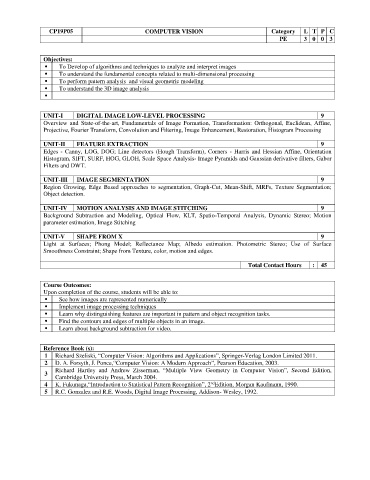
CP19P05                         COMPUTER VISION                           Category   L  T  P  C
                                                                                              PE      3  0  0  3


               Objectives:
                ⚫    To Develop of algorithms and techniques to analyze and interpret images
                ⚫    To understand the fundamental concepts related to multi-dimensional processing
                ⚫    To perform pattern analysis  and visual geometric modeling
                ⚫    To understand the 3D image analysis
                ⚫


               UNIT-I     DIGITAL IMAGE LOW-LEVEL PROCESSING                                               9
               Overview  and  State-of-the-art,  Fundamentals  of  Image  Formation,  Transformation:  Orthogonal,  Euclidean,  Affine,
               Projective, Fourier Transform, Convolution and Filtering, Image Enhancement, Restoration, Histogram Processing

               UNIT-II    FEATURE EXTRACTION                                                               9
               Edges - Canny, LOG, DOG; Line detectors (Hough Transform), Corners  - Harris and Hessian Affine, Orientation
               Histogram, SIFT, SURF, HOG, GLOH, Scale Space Analysis- Image Pyramids and Gaussian derivative filters, Gabor
               Filters and DWT.

               UNIT-III   IMAGE SEGMENTATION                                                               9
               Region  Growing,  Edge  Based  approaches  to  segmentation,  Graph-Cut,  Mean-Shift,  MRFs,  Texture  Segmentation;
               Object detection.

               UNIT-IV    MOTION ANALYSIS AND IMAGE STITCHING                                              9
               Background  Subtraction  and  Modeling,  Optical  Flow,  KLT,  Spatio-Temporal  Analysis,  Dynamic  Stereo;  Motion
               parameter estimation, Image Stitching

               UNIT-V     SHAPE FROM X                                                                     9
               Light  at  Surfaces;  Phong  Model;  Reflectance  Map;  Albedo  estimation.  Photometric  Stereo;  Use  of  Surface
               Smoothness Constraint; Shape from Texture, color, motion and edges.

                                                                                   Total Contact Hours   :  45

               Course Outcomes:
               Upon completion of the course, students will be able to:
                ⚫    See how images are represented numerically
                ⚫    Implement image processing techniques
                ⚫    Learn why distinguishing features are important in pattern and object recognition tasks.
                ⚫    Find the contours and edges of multiple objects in an image.
                ⚫    Learn about background subtraction for video.


               Reference Book (s):
                1   Richard Szeliski, “Computer Vision: Algorithms and Applications”, Springer-Verlag London Limited 2011.
                2   D. A. Forsyth, J. Ponce,“Computer Vision: A Modern Approach”, Pearson Education, 2003.
                   Richard  Hartley  and  Andrew  Zisserman,  “Multiple  View  Geometry  in  Computer  Vision”,  Second  Edition,
                3
                   Cambridge University Press, March 2004.
                                                                       nd
                4   K. Fukunaga,“Introduction to Statistical Pattern Recognition”, 2 Edition, Morgan Kaufmann, 1990.
                5   R.C. Gonzalez and R.E. Woods, Digital Image Processing, Addison- Wesley, 1992.

