


Page 192 - Applied Statistics with R
P. 192
192                                 CHAPTER 10. MODEL BUILDING


                                                                        1

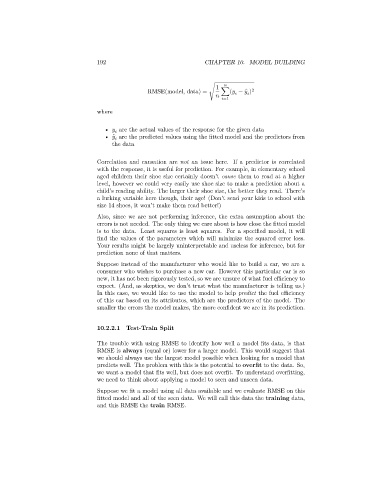
                                                  RMSE(model, data) = √   ∑(   − ̂ ) 2


                                                                            =1
                                 where
                                    •    are the actual values of the response for the given data

                                    •    are the predicted values using the fitted model and the predictors from
                                       ̂

                                      the data
                                 Correlation and causation are not an issue here. If a predictor is correlated
                                 with the response, it is useful for prediction. For example, in elementary school
                                 aged children their shoe size certainly doesn’t cause them to read at a higher
                                 level, however we could very easily use shoe size to make a prediction about a
                                 child’s reading ability. The larger their shoe size, the better they read. There’s
                                 a lurking variable here though, their age! (Don’t send your kids to school with
                                 size 14 shoes, it won’t make them read better!)
                                 Also, since we are not performing inference, the extra assumption about the
                                 errors is not needed. The only thing we care about is how close the fitted model
                                 is to the data. Least squares is least squares. For a specified model, it will
                                 find the values of the parameters which will minimize the squared error loss.
                                 Your results might be largely uninterpretable and useless for inference, but for
                                 prediction none of that matters.
                                 Suppose instead of the manufacturer who would like to build a car, we are a
                                 consumer who wishes to purchase a new car. However this particular car is so
                                 new, it has not been rigorously tested, so we are unsure of what fuel efficiency to
                                 expect. (And, as skeptics, we don’t trust what the manufacturer is telling us.)
                                 In this case, we would like to use the model to help predict the fuel efficiency
                                 of this car based on its attributes, which are the predictors of the model. The
                                 smaller the errors the model makes, the more confident we are in its prediction.


                                 10.2.2.1 Test-Train Split

                                 The trouble with using RMSE to identify how well a model fits data, is that
                                 RMSE is always (equal or) lower for a larger model. This would suggest that
                                 we should always use the largest model possible when looking for a model that
                                 predicts well. The problem with this is the potential to overfit to the data. So,
                                 we want a model that fits well, but does not overfit. To understand overfitting,
                                 we need to think about applying a model to seen and unseen data.
                                 Suppose we fit a model using all data available and we evaluate RMSE on this
                                 fitted model and all of the seen data. We will call this data the training data,
                                 and this RMSE the train RMSE.

