


Page 188 - Applied Statistics with R
P. 188
188                                 CHAPTER 10. MODEL BUILDING


                                 In linear regression, we specified models with parameters,    and fit the model

                                 by finding the best values of these parameters. This is a parametric approach. A
                                 non-parametric approach skips the step of specifying a model with parameters,
                                 and are often described as more of an algorithm. Non-parametric models are
                                 often used in machine learning.


                                              Linear Regression                    Smoothing

                                    10                                 10


                                    5                                  5
                                  Response                           Response

                                    0                                  0


                                    -5                                 -5

                                       0    2    4    6    8    10       0    2    4    6    8    10
                                                  Predictor                         Predictor


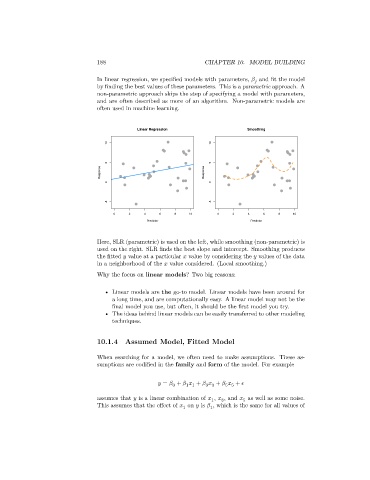
                                 Here, SLR (parametric) is used on the left, while smoothing (non-parametric) is
                                 used on the right. SLR finds the best slope and intercept. Smoothing produces
                                 the fitted    value at a particular    value by considering the    values of the data
                                 in a neighborhood of the    value considered. (Local smoothing.)
                                 Why the focus on linear models? Two big reasons:


                                    • Linear models are the go-to model. Linear models have been around for
                                      a long time, and are computationally easy. A linear model may not be the
                                      final model you use, but often, it should be the first model you try.
                                    • The ideas behind linear models can be easily transferred to other modeling
                                      techniques.


                                 10.1.4   Assumed Model, Fitted Model

                                 When searching for a model, we often need to make assumptions. These as-
                                 sumptions are codified in the family and form of the model. For example


                                                        =    +       +       +       +
                                                                            5 5
                                                               1 1
                                                                     3 3
                                                          0
                                 assumes that    is a linear combination of    ,    , and    as well as some noise.
                                                                          3
                                                                       1
                                                                                 5
                                 This assumes that the effect of    on    is    , which is the same for all values of
                                                              1
                                                                       1

