


Page 191 - Applied Statistics with R
P. 191
10.2. EXPLANATION VERSUS PREDICTION                               191


                      plot(mpg ~ hp, data = autompg, col = "dodgerblue", pch = 20, cex = 1.5)


                             40


                        mpg  30

                             20


                             10

                                 50            100           150           200

                                                          hp


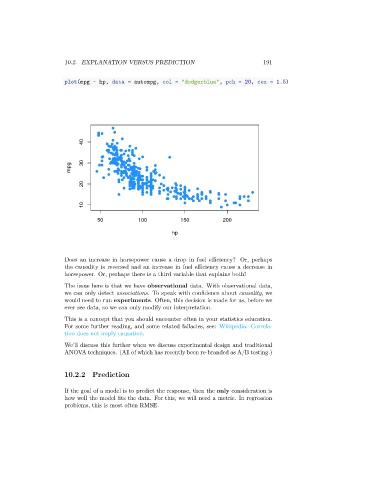
                      Does an increase in horsepower cause a drop in fuel efficiency? Or, perhaps
                      the causality is reversed and an increase in fuel efficiency cause a decrease in
                      horsepower. Or, perhaps there is a third variable that explains both!
                      The issue here is that we have observational data. With observational data,
                      we can only detect associations. To speak with confidence about causality, we
                      would need to run experiments. Often, this decision is made for us, before we
                      ever see data, so we can only modify our interpretation.
                      This is a concept that you should encounter often in your statistics education.
                      For some further reading, and some related fallacies, see: Wikipedia: Correla-
                      tion does not imply causation.
                      We’ll discuss this further when we discuss experimental design and traditional
                      ANOVA techniques. (All of which has recently been re-branded as A/B testing.)


                      10.2.2    Prediction


                      If the goal of a model is to predict the response, then the only consideration is
                      how well the model fits the data. For this, we will need a metric. In regression
                      problems, this is most often RMSE.

