


Page 211 - Applied Statistics with R
P. 211
11.2. INTERACTIONS                                                211


                      ## 2     379 5754.2  1     1822.3 120.03 < 2.2e-16 ***
                      ## ---
                      ## Signif. codes:   0 '***' 0.001 '**' 0.01 '*' 0.05 '.' 0.1 ' ' 1

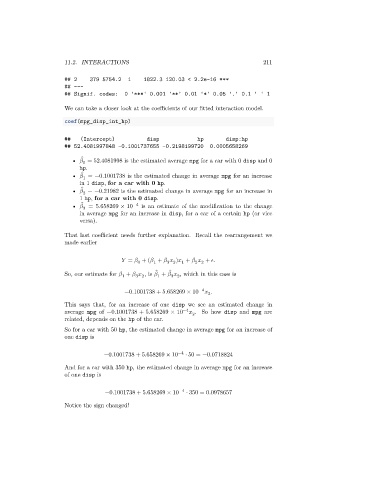
                      We can take a closer look at the coefficients of our fitted interaction model.
                      coef(mpg_disp_int_hp)


                      ##    (Intercept)           disp            hp        disp:hp
                      ## 52.4081997848 -0.1001737655 -0.2198199720    0.0005658269
                             ̂
                         •    = 52.4081998 is the estimated average mpg for a car with 0 disp and 0
                            0
                           hp.
                             ̂
                         •    = −0.1001738 is the estimated change in average mpg for an increase
                            1
                           in 1 disp, for a car with 0 hp.
                             ̂
                         •    = −0.21982 is the estimated change in average mpg for an increase in
                            2
                           1 hp, for a car with 0 disp.
                             ̂
                         •    = 5.658269 × 10 −4  is an estimate of the modification to the change
                            3
                           in average mpg for an increase in disp, for a car of a certain hp (or vice
                           versa).
                      That last coefficient needs further explanation. Recall the rearrangement we
                      made earlier

                                            =    + (   +       )   +       +   .
                                                                  2 2
                                                    1
                                                             1
                                               0
                                                        3 2
                                                     ̂
                                                          ̂
                      So, our estimate for    +       , is    +       , which in this case is
                                              3 2
                                                          3 2
                                                     1
                                         1
                                                                   −4
                                          −0.1001738 + 5.658269 × 10    .
                                                                      2
                      This says that, for an increase of one disp we see an estimated change in
                                                              −4
                      average mpg of −0.1001738 + 5.658269 × 10    . So how disp and mpg are
                                                                 2
                      related, depends on the hp of the car.
                      So for a car with 50 hp, the estimated change in average mpg for an increase of
                      one disp is
                                   −0.1001738 + 5.658269 × 10 −4  ⋅ 50 = −0.0718824
                      And for a car with 350 hp, the estimated change in average mpg for an increase
                      of one disp is
                                    −0.1001738 + 5.658269 × 10 −4  ⋅ 350 = 0.0978657

                      Notice the sign changed!

