


Page 210 - Applied Statistics with R
P. 210
210 CHAPTER 11. CATEGORICAL PREDICTORS AND INTERACTIONS


                                 Since we’re now working in three dimensions, this model can’t be easily justified
                                 via visualizations like the previous example. Instead, we will have to rely on a
                                 test.

                                 mpg_disp_add_hp = lm(mpg ~ disp + hp, data = autompg)
                                 mpg_disp_int_hp = lm(mpg ~ disp * hp, data = autompg)
                                 summary(mpg_disp_int_hp)


                                 ##
                                 ## Call:
                                 ## lm(formula = mpg ~ disp * hp, data = autompg)
                                 ##
                                 ## Residuals:
                                 ##       Min       1Q   Median        3Q      Max
                                 ## -10.7849   -2.3104  -0.5699    2.1453  17.9211
                                 ##
                                 ## Coefficients:
                                 ##                Estimate Std. Error t value Pr(>|t|)
                                 ## (Intercept)   5.241e+01  1.523e+00    34.42   <2e-16 ***
                                 ## disp         -1.002e-01  6.638e-03   -15.09   <2e-16 ***
                                 ## hp           -2.198e-01  1.987e-02   -11.06   <2e-16 ***
                                 ## disp:hp       5.658e-04  5.165e-05    10.96   <2e-16 ***
                                 ## ---
                                 ## Signif. codes:   0 '***' 0.001 '**' 0.01 '*' 0.05 '.' 0.1 ' ' 1
                                 ##
                                 ## Residual standard error: 3.896 on 379 degrees of freedom
                                 ## Multiple R-squared:   0.7554, Adjusted R-squared:    0.7535
                                 ## F-statistic: 390.2 on 3 and 379 DF,    p-value: < 2.2e-16

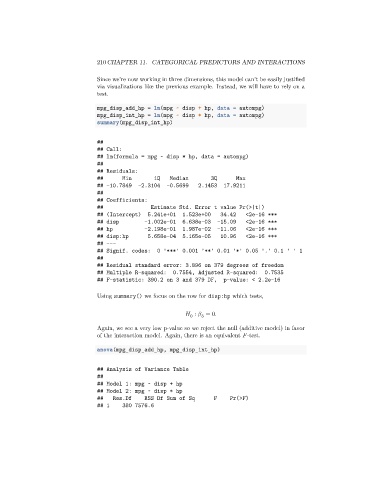
                                 Using summary() we focus on the row for disp:hp which tests,


                                                                 ∶    = 0.
                                                                0
                                                                    3
                                 Again, we see a very low p-value so we reject the null (additive model) in favor
                                 of the interaction model. Again, there is an equivalent   -test.


                                 anova(mpg_disp_add_hp, mpg_disp_int_hp)


                                 ## Analysis of Variance Table
                                 ##
                                 ## Model 1: mpg ~ disp + hp
                                 ## Model 2: mpg ~ disp * hp
                                 ##   Res.Df     RSS Df Sum of Sq       F    Pr(>F)
                                 ## 1     380 7576.6

