


Page 207 - Applied Statistics with R
P. 207
11.2. INTERACTIONS                                                207


                      coef(mpg_disp_int)


                      ##    (Intercept)           disp      domestic disp:domestic
                      ##     46.0548423    -0.1569239    -12.5754714      0.1025184
                      coef(mpg_disp_int2)


                      ##    (Intercept)           disp      domestic disp:domestic
                      ##     46.0548423    -0.1569239    -12.5754714      0.1025184

                      We see that both the variables, and their coefficient estimates are indeed the
                      same for both models.

                      summary(mpg_disp_int)


                      ##
                      ## Call:
                      ## lm(formula = mpg ~ disp + domestic + disp:domestic, data = autompg)
                      ##
                      ## Residuals:
                      ##       Min       1Q   Median        3Q      Max
                      ## -10.8332   -2.8956  -0.8332    2.2828  18.7749
                      ##
                      ## Coefficients:
                      ##                 Estimate Std. Error t value Pr(>|t|)
                      ## (Intercept)     46.05484     1.80582  25.504   < 2e-16 ***
                      ## disp            -0.15692     0.01668  -9.407   < 2e-16 ***
                      ## domestic       -12.57547     1.95644  -6.428 3.90e-10 ***
                      ## disp:domestic    0.10252     0.01692   6.060 3.29e-09 ***
                      ## ---
                      ## Signif. codes:   0 '***' 0.001 '**' 0.01 '*' 0.05 '.' 0.1 ' ' 1
                      ##
                      ## Residual standard error: 4.308 on 379 degrees of freedom
                      ## Multiple R-squared:   0.7011, Adjusted R-squared:    0.6987
                      ## F-statistic: 296.3 on 3 and 379 DF,    p-value: < 2.2e-16

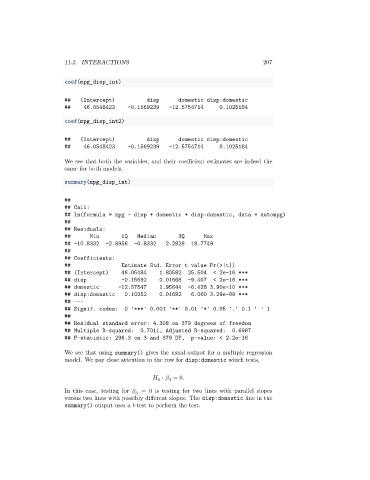
                      We see that using summary() gives the usual output for a multiple regression
                      model. We pay close attention to the row for disp:domestic which tests,

                                                       ∶    = 0.
                                                         3
                                                     0
                      In this case, testing for    = 0 is testing for two lines with parallel slopes
                                              3
                      versus two lines with possibly different slopes. The disp:domestic line in the
                      summary() output uses a   -test to perform the test.

