


Page 214 - Applied Statistics with R
P. 214
214 CHAPTER 11. CATEGORICAL PREDICTORS AND INTERACTIONS


                                 So here we see that

                                                   ̂
                                               ̂
                                                +    = 46.0548423 + −12.5754714 = 33.4793709
                                              0
                                                   2
                                 is the estimated average mpg for a domestic car with 0 disp.
                                 Now let’s try to do the same, but using our new factor variable.

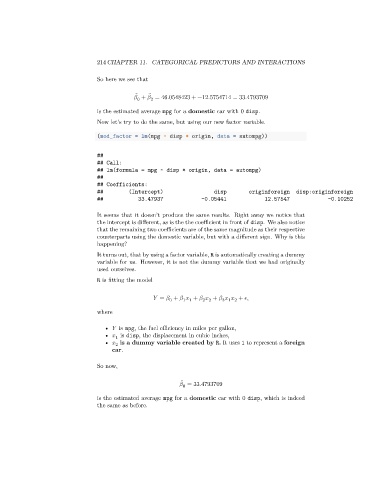
                                 (mod_factor = lm(mpg ~ disp * origin, data = autompg))


                                 ##
                                 ## Call:
                                 ## lm(formula = mpg ~ disp * origin, data = autompg)
                                 ##
                                 ## Coefficients:
                                 ##         (Intercept)                 disp       originforeign   disp:originforeign
                                 ##            33.47937             -0.05441             12.57547            -0.10252


                                 It seems that it doesn’t produce the same results. Right away we notice that
                                 the intercept is different, as is the the coefficient in front of disp. We also notice
                                 that the remaining two coefficients are of the same magnitude as their respective
                                 counterparts using the domestic variable, but with a different sign. Why is this
                                 happening?
                                 It turns out, that by using a factor variable, R is automatically creating a dummy
                                 variable for us. However, it is not the dummy variable that we had originally
                                 used ourselves.
                                 R is fitting the model


                                                       =    +       +       +          +   ,
                                                                    2 2
                                                                           3 1 2
                                                         0
                                                              1 1
                                 where
                                    •    is mpg, the fuel efficiency in miles per gallon,
                                    •    is disp, the displacement in cubic inches,
                                       1
                                    •    is a dummy variable created by R. It uses 1 to represent a foreign
                                       2
                                      car.

                                 So now,

                                                              ̂
                                                               = 33.4793709
                                                              0
                                 is the estimated average mpg for a domestic car with 0 disp, which is indeed
                                 the same as before.

