


Page 23 - Applied Statistics with R
P. 23
3.2. DATA STRUCTURES                                               23


                      stay consistent. Also, if working on a larger collaborative project, you should
                      use whatever style is already in place.

                      Because vectors must contain elements that are all the same type, R will au-
                      tomatically coerce to a single type when attempting to create a vector that
                      combines multiple types.

                      c(42, "Statistics", TRUE)


                      ## [1] "42"          "Statistics" "TRUE"


                      c(42, TRUE)


                      ## [1] 42   1


                      Frequently you may wish to create a vector based on a sequence of numbers.
                      The quickest and easiest way to do this is with the : operator, which creates a
                      sequence of integers between two specified integers.


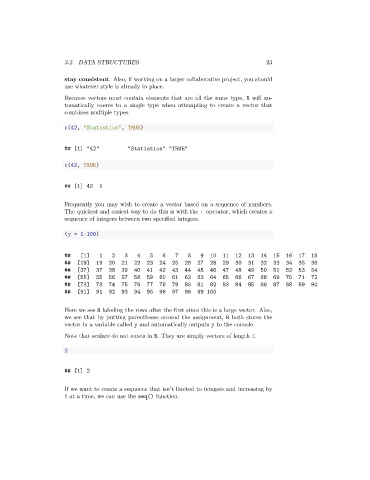
                      (y = 1:100)


                      ##    [1]   1   2   3   4    5   6   7   8   9  10   11  12  13  14  15   16  17  18
                      ##   [19]  19  20  21  22   23  24  25  26  27  28   29  30  31  32  33   34  35  36
                      ##   [37]  37  38  39  40   41  42  43  44  45  46   47  48  49  50  51   52  53  54
                      ##   [55]  55  56  57  58   59  60  61  62  63  64   65  66  67  68  69   70  71  72
                      ##   [73]  73  74  75  76   77  78  79  80  81  82   83  84  85  86  87   88  89  90
                      ##   [91]  91  92  93  94   95  96  97  98  99 100

                      Here we see R labeling the rows after the first since this is a large vector. Also,
                      we see that by putting parentheses around the assignment, R both stores the
                      vector in a variable called y and automatically outputs y to the console.

                      Note that scalars do not exists in R. They are simply vectors of length 1.

                      2


                      ## [1] 2


                      If we want to create a sequence that isn’t limited to integers and increasing by
                      1 at a time, we can use the seq() function.

