


Page 27 - Applied Statistics with R
P. 27
3.2. DATA STRUCTURES                                               27


                      3.2.3   Logical Operators


                       Operator   Summary                   Example                 Result
                       x < y      x less than y             3 < 42                  TRUE
                       x > y      x greater than y          3 > 42                  FALSE
                       x <= y     x less than or equal to y  3 <= 42                TRUE
                       x >= y     x greater than or equal to y  3 >= 42             FALSE
                       x == y     xequal to y               3 == 42                 FALSE
                       x != y     x not equal to y          3 != 42                 TRUE
                       !x         not x                     !(3 > 42)               TRUE
                       x | y      x or y                    (3 > 42) | TRUE         TRUE
                       x & y      x and y                   (3 < 4) & ( 42 > 13)    TRUE


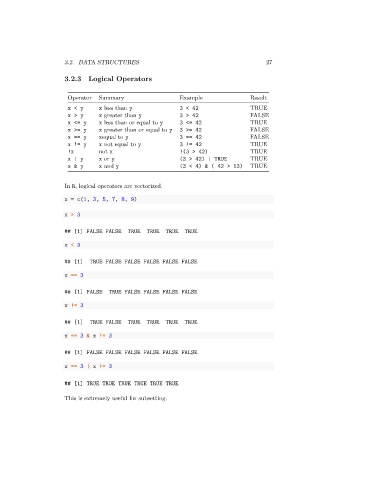
                      In R, logical operators are vectorized.
                      x = c(1, 3, 5, 7, 8, 9)


                      x > 3

                      ## [1] FALSE FALSE   TRUE   TRUE  TRUE  TRUE

                      x < 3

                      ## [1]   TRUE FALSE FALSE FALSE FALSE FALSE

                      x == 3


                      ## [1] FALSE   TRUE FALSE FALSE FALSE FALSE
                      x != 3


                      ## [1]   TRUE FALSE  TRUE   TRUE  TRUE  TRUE

                      x == 3 & x != 3

                      ## [1] FALSE FALSE FALSE FALSE FALSE FALSE

                      x == 3 | x != 3

                      ## [1] TRUE TRUE TRUE TRUE TRUE TRUE


                      This is extremely useful for subsetting.

