


Page 24 - Applied Statistics with R
P. 24
24                         CHAPTER 3. DATA AND PROGRAMMING


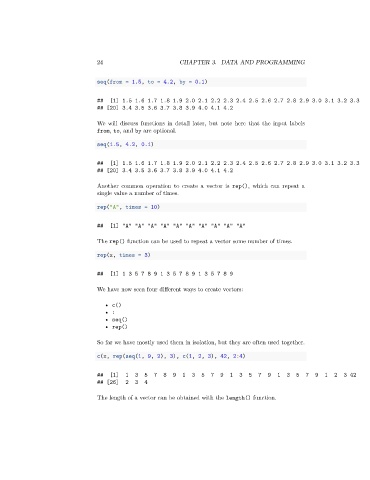
                                 seq(from = 1.5, to = 4.2, by = 0.1)


                                 ##  [1] 1.5 1.6 1.7 1.8 1.9 2.0 2.1 2.2 2.3 2.4 2.5 2.6 2.7 2.8 2.9 3.0 3.1 3.2 3.3
                                 ## [20] 3.4 3.5 3.6 3.7 3.8 3.9 4.0 4.1 4.2

                                 We will discuss functions in detail later, but note here that the input labels
                                 from, to, and by are optional.

                                 seq(1.5, 4.2, 0.1)


                                 ##  [1] 1.5 1.6 1.7 1.8 1.9 2.0 2.1 2.2 2.3 2.4 2.5 2.6 2.7 2.8 2.9 3.0 3.1 3.2 3.3
                                 ## [20] 3.4 3.5 3.6 3.7 3.8 3.9 4.0 4.1 4.2


                                 Another common operation to create a vector is rep(), which can repeat a
                                 single value a number of times.

                                 rep("A", times = 10)


                                 ##  [1] "A" "A" "A" "A" "A" "A" "A" "A" "A" "A"

                                 The rep() function can be used to repeat a vector some number of times.

                                 rep(x, times = 3)


                                 ##  [1] 1 3 5 7 8 9 1 3 5 7 8 9 1 3 5 7 8 9

                                 We have now seen four different ways to create vectors:

                                    • c()
                                    • :
                                    • seq()
                                    • rep()

                                 So far we have mostly used them in isolation, but they are often used together.

                                 c(x, rep(seq(1, 9, 2), 3), c(1, 2, 3), 42, 2:4)


                                 ##  [1]   1  3  5  7  8  9  1   3  5  7  9  1  3  5  7   9  1  3  5  7  9  1   2  3 42
                                 ## [26]   2  3  4

                                 The length of a vector can be obtained with the length() function.

