


Page 35 - Applied Statistics with R
P. 35
3.2. DATA STRUCTURES                                               35


                      ##            [,1]      [,2]      [,3]
                      ## [1,] 0.1111111 0.6666667 2.333333
                      ## [2,] 0.2500000 1.0000000 4.000000
                      ## [3,] 0.4285714 1.5000000 9.000000

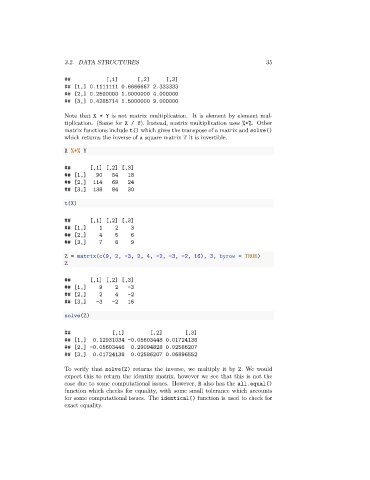
                      Note that X * Y is not matrix multiplication. It is element by element mul-
                      tiplication. (Same for X / Y). Instead, matrix multiplication uses %*%. Other
                      matrix functions include t() which gives the transpose of a matrix and solve()
                      which returns the inverse of a square matrix if it is invertible.
                      X %*% Y


                      ##       [,1] [,2] [,3]
                      ## [1,]    90   54   18
                      ## [2,]   114   69   24
                      ## [3,]   138   84   30

                      t(X)


                      ##       [,1] [,2] [,3]
                      ## [1,]     1    2    3
                      ## [2,]     4    5    6
                      ## [3,]     7    8    9

                      Z = matrix(c(9, 2, -3, 2, 4, -2, -3, -2, 16), 3, byrow = TRUE)
                      Z

                      ##       [,1] [,2] [,3]
                      ## [1,]     9    2   -3
                      ## [2,]     2    4   -2
                      ## [3,]    -3   -2   16
                      solve(Z)


                      ##              [,1]         [,2]       [,3]
                      ## [1,]   0.12931034 -0.05603448 0.01724138
                      ## [2,] -0.05603448   0.29094828 0.02586207
                      ## [3,]   0.01724138  0.02586207 0.06896552


                      To verify that solve(Z) returns the inverse, we multiply it by Z. We would
                      expect this to return the identity matrix, however we see that this is not the
                      case due to some computational issues. However, R also has the all.equal()
                      function which checks for equality, with some small tolerance which accounts
                      for some computational issues. The identical() function is used to check for
                      exact equality.

