


Page 38 - Applied Statistics with R
P. 38
38                         CHAPTER 3. DATA AND PROGRAMMING


                                 Calculations with Vectors and Matrices

                                 Certain operations in R, for example %*% have different behavior on vectors and
                                 matrices. To illustrate this, we will first create two vectors.

                                 a_vec = c(1, 2, 3)
                                 b_vec = c(2, 2, 2)


                                 Note that these are indeed vectors. They are not matrices.

                                 c(is.vector(a_vec), is.vector(b_vec))


                                 ## [1] TRUE TRUE

                                 c(is.matrix(a_vec), is.matrix(b_vec))


                                 ## [1] FALSE FALSE

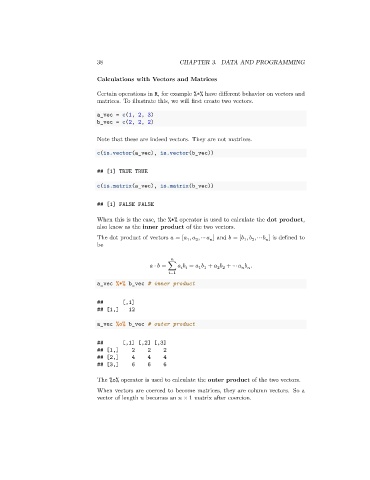
                                 When this is the case, the %*% operator is used to calculate the dot product,
                                 also know as the inner product of the two vectors.
                                 The dot product of vectors    = [   ,    , ⋯    ] and    = [   ,    , ⋯    ] is defined to
                                                                                    2


                                                                                  1
                                                               1
                                                                  2
                                 be

                                                      ⋅    = ∑       =       +       + ⋯       .
                                                                   1 1


                                                                         2 2
                                                           =1
                                 a_vec %*% b_vec # inner product
                                 ##       [,1]
                                 ## [1,]    12
                                 a_vec %o% b_vec # outer product


                                 ##       [,1] [,2] [,3]
                                 ## [1,]     2    2    2
                                 ## [2,]     4    4    4
                                 ## [3,]     6    6    6


                                 The %o% operator is used to calculate the outer product of the two vectors.
                                 When vectors are coerced to become matrices, they are column vectors. So a
                                 vector of length    becomes an    × 1 matrix after coercion.

