


Page 418 - Applied Statistics with R
P. 418
418                           CHAPTER 17. LOGISTIC REGRESSION


                                 Now we’ll allow for two modifications of this situation, which will let us use linear
                                 models in many more situations. Instead of using a normal distribution for the
                                 response conditioned on the predictors, we’ll allow for other distributions. Also,
                                 instead of the conditional mean being a linear combination of the predictors, it
                                 can be some function of a linear combination of the predictors.
                                 In general, a generalized linear model has three parts:


                                    • A distribution of the response conditioned on the predictors. (Techni-
                                      cally this distribution needs to be from the exponential family of distri-
                                      butions.)
                                    • A linear combination of the    − 1 predictors,    +       +       + … +
                                                                                             2 2
                                                                                      1 1
                                                                                  0

                                           −1   −1 , which we write as   (x). That is,

                                                    (x) =    +       +       + … +      −1   −1
                                                                    2 2
                                                         0
                                                              1 1
                                    • A link function,   (), that defines how   (x), the linear combination of
                                      the predictors, is related to the mean of the response conditioned on the
                                      predictors, E[   ∣ X = x].


                                                           (x) =    (E[   ∣ X = x]) .

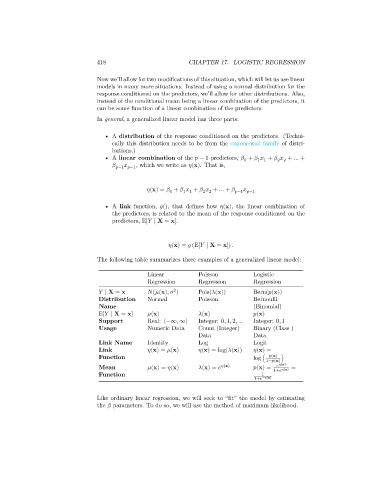
                                 The following table summarizes three examples of a generalized linear model:

                                                  Linear           Poisson           Logistic
                                                  Regression       Regression        Regression
                                                          2
                                     ∣ X = x        (  (x),    )   Pois(  (x))       Bern(  (x))
                                  Distribution    Normal           Poisson           Bernoulli
                                  Name                                               (Binomial)
                                  E[   ∣ X = x]     (x)              (x)               (x)
                                  Support         Real: (−∞, ∞)    Integer: 0, 1, 2, …  Integer: 0, 1
                                  Usage           Numeric Data     Count (Integer)   Binary (Class )
                                                                   Data              Data
                                  Link Name       Identity         Log               Logit
                                  Link              (x) =   (x)      (x) = log(  (x))    (x) =
                                  Function                                           log (    (x)  )
                                                                                         1−  (x)
                                                                                               (x)

                                  Mean              (x) =   (x)      (x) =      (x)    (x) =  1+     (x) =
                                  Function                                              1
                                                                                     1+   −  (x)

                                 Like ordinary linear regression, we will seek to “fit” the model by estimating
                                 the    parameters. To do so, we will use the method of maximum likelihood.

