


Page 421 - Applied Statistics with R
P. 421
17.2. BINARY RESPONSE                                             421


                      So even though we introduced ordinary linear regression first, in some ways,
                      logistic regression is actually simpler.

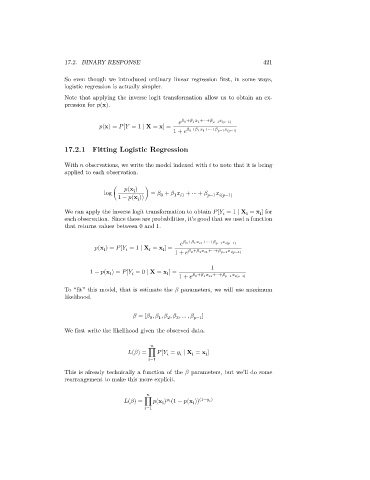
                      Note that applying the inverse logit transformation allow us to obtain an ex-
                      pression for   (x).


                                                                  0 +   1    1 +⋯+     −1    (  −1)
                                    (x) =   [   = 1 ∣ X = x] =
                                                          1 +       0 +   1    1 +⋯+     −1    (  −1)

                      17.2.1    Fitting Logistic Regression

                      With    observations, we write the model indexed with    to note that it is being
                      applied to each observation.

                                            (x )
                                             i

                                   log (         ) =    +       + ⋯ +      −1   (  −1)
                                                      0
                                                           1   1
                                        1 −   (x ))
                                              i
                      We can apply the inverse logit transformation to obtain   [   = 1 ∣ X = x ] for
                                                                                       i
                                                                                  i

                      each observation. Since these are probabilities, it’s good that we used a function
                      that returns values between 0 and 1.
                                                                   0 +   1      1 +⋯+     −1      (  −1)
                                  (x ) =   [   = 1 ∣ X = x ] =
                                                  i
                                   i

                                                       i
                                                           1 +       0 +   1      1 +⋯+     −1      (  −1)
                                                                       1
                               1 −   (x ) =   [   = 0 ∣ X = x ] =
                                                        i

                                     i
                                                            1 +       0 +   1      1 +⋯+     −1      (  −1)
                      To “fit” this model, that is estimate the    parameters, we will use maximum
                      likelihood.
                                                = [   ,    ,    ,    , … ,      −1 ]
                                                        2
                                                   0
                                                           3
                                                     1
                      We first write the likelihood given the observed data.

                                             (  ) = ∏   [   =    ∣ X = x ]


                                                                 i
                                                                     i
                                                    =1
                      This is already technically a function of the    parameters, but we’ll do some
                      rearrangement to make this more explicit.


                                            (  ) = ∏   (x )    (1 −   (x )) (1−      )
                                                       i
                                                                 i
                                                   =1

