


Page 420 - Applied Statistics with R
P. 420
420                           CHAPTER 17. LOGISTIC REGRESSION


                                 more machine learning focused texts will use    as the number of predictors.
                                 This is an arbitrary choice, but you should be aware of it.)

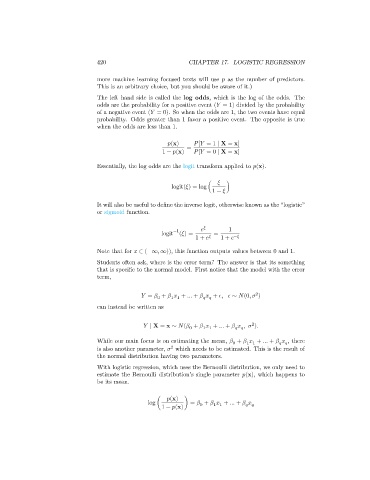
                                 The left hand side is called the log odds, which is the log of the odds. The
                                 odds are the probability for a positive event (   = 1) divided by the probability
                                 of a negative event (   = 0). So when the odds are 1, the two events have equal
                                 probability. Odds greater than 1 favor a positive event. The opposite is true
                                 when the odds are less than 1.

                                                          (x)  =    [   = 1 ∣ X = x]
                                                       1 −   (x)    [   = 0 ∣ X = x]

                                 Essentially, the log odds are the logit transform applied to   (x).


                                                          logit(  ) = log (  )
                                                                       1 −

                                 It will also be useful to define the inverse logit, otherwise known as the “logistic”
                                 or sigmoid function.


                                                          −1
                                                      logit (  ) =         =  1
                                                                  1 +        1 +    −
                                 Note that for    ∈ (−∞, ∞)), this function outputs values between 0 and 1.

                                 Students often ask, where is the error term? The answer is that its something
                                 that is specific to the normal model. First notice that the model with the error
                                 term,


                                                                                      2
                                                   =    +       + … +       +   ,    ∼   (0,    )
                                                          1 1

                                                     0
                                 can instead be written as
                                                                                    2
                                                   ∣ X = x ∼   (   +       + … +       ,    ).
                                                                0

                                                                    1 1
                                 While our main focus is on estimating the mean,    +       + … +       , there
                                                                              0
                                                                                   1 1

                                                          2
                                 is also another parameter,    which needs to be estimated. This is the result of
                                 the normal distribution having two parameters.
                                 With logistic regression, which uses the Bernoulli distribution, we only need to
                                 estimate the Bernoulli distribution’s single parameter   (x), which happens to
                                 be its mean.
                                                          (x)
                                                  log (       ) =    +       + … +
1 − (x) 0 1 1 

