


Page 91 - Applied Statistics with R
P. 91
7.1. MODELING                                                      91


                                             Stopping Distance vs Speed

                             120  100
                        Stopping Distance (in Feet)  80  60  40


                             0  20
                                   5           10          15          20           25

                                                 Speed (in Miles Per Hour)


                      Let’s now define some terminology. We have pairs of data, (   ,    ), for    =


                      1, 2, …   , where    is the sample size of the dataset.
                      We use    as an index, simply for notation. We use    as the predictor (ex-

                      planatory) variable. The predictor variable is used to help predict or explain
                      the response (target, outcome) variable,    .

                      Other texts may use the term independent variable instead of predictor and
                      dependent variable in place of response. However, those monikers imply math-
                      ematical characteristics that might not be true. While these other terms are
                      not incorrect, independence is already a strictly defined concept in probability.
                      For example, when trying to predict a person’s weight given their height, would
                      it be accurate to say that height is independent of weight? Certainly not, but
                      that is an unintended implication of saying “independent variable.” We prefer
                      to stay away from this nomenclature.

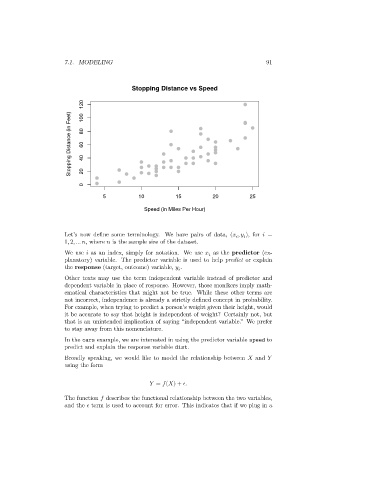
                      In the cars example, we are interested in using the predictor variable speed to
                      predict and explain the response variable dist.
                      Broadly speaking, we would like to model the relationship between    and
                      using the form

                                                      =   (  ) +   .


                      The function    describes the functional relationship between the two variables,
                      and the    term is used to account for error. This indicates that if we plug in a

