


Page 92 - Applied Statistics with R
P. 92
92                       CHAPTER 7. SIMPLE LINEAR REGRESSION


                                 given value of    as input, our output is a value of    , within a certain range of
                                 error. You could think of this a number of ways:


                                    • Response = Prediction + Error
                                    • Response = Signal + Noise
                                    • Response = Model + Unexplained
                                    • Response = Deterministic + Random
                                    • Response = Explainable + Unexplainable

                                 What sort of function should we use for   (  ) for the cars data?
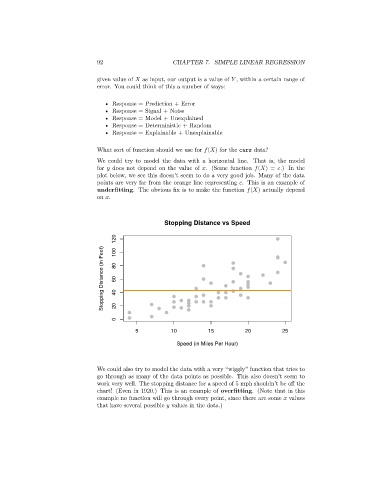
                                 We could try to model the data with a horizontal line. That is, the model
                                 for    does not depend on the value of   . (Some function   (  ) =   .) In the
                                 plot below, we see this doesn’t seem to do a very good job. Many of the data
                                 points are very far from the orange line representing   . This is an example of
                                 underfitting. The obvious fix is to make the function   (  ) actually depend
                                 on   .


                                                       Stopping Distance vs Speed

                                       120  100

                                   Stopping Distance (in Feet)  80  60  40


                                       0  20
                                              5           10          15          20          25
                                                           Speed (in Miles Per Hour)


                                 We could also try to model the data with a very “wiggly” function that tries to
                                 go through as many of the data points as possible. This also doesn’t seem to
                                 work very well. The stopping distance for a speed of 5 mph shouldn’t be off the
                                 chart! (Even in 1920.) This is an example of overfitting. (Note that in this
                                 example no function will go through every point, since there are some    values
                                 that have several possible    values in the data.)

