


Page 70 - 2000
P. 70
Supplied by AP
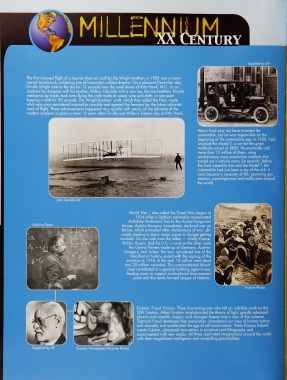
The first manned flight of a heavier-than-air craft by the W right brothers in 1903 was a monu
mental benchmark, achieving one of humanity's wildest dreams. On a pleasant December day,
O rville W right took to the sky for 12 seconds over the sand dunes of Kitty Hawk, N.C., in an
airplane he designed with his brother, W ilbur. Like kids with a new toy, the two brothers, bicycle
mechanics by trade, took turns flying the craft made of wood, wire and cloth, at one point
keeping it aloft for 59 seconds. The W right brothers' craft, which they called the Flyer, made
what was once considered impossible possible and opened the heavens for the future advance
ment of flight. Those advancements happened very quickly with nearly all the elements of the
modern airplane in place a mere 15 years after O rville and W ilb u r's historic day at Kitty Hawk.
Henry Ford may not have invented the
automobile, but he was responsible for the
beginning of the automobile age. In 1908, Ford
f t | I | unveiled the Model T, a car for the great
1 1 1 1 multitude priced at $850. He eventually sold
more than 15 million of them, using
b l
revolutionary mass production methods that
turned out a vehicle every 24 seconds. Before
the Ford assembly line and the Model T, the
automobile had just been a toy of the rich. It
soon became a necessity of life, spawning gas
stations, superhighways and traffic jams around
the world.
John Daniels/AP
W orld W a r I, also called the Great War, began in
1914 when a Serbian nationalist assassinated
Archduke Ferdinand, heir to the Austro-Hungarian
Archive Photos
throne. Austria-Hungary immediately declared war on
Serbia, which prompted other declarations of war, ulti
mately leading to every major power in Europe getting
involved. On one side were the Allies — chiefly France,
Britain, Russia, and the U.S. — and on the other were
the Central Powers made up of Germany, Austria-
Hungary, and Turkey. The war, considered one of the
bloodiest in history, ended with the signing of the
armistice in 1918. In the end, 10 million were dead
and 20 million wounded. This unprecedented blood
shed contributed to a general loathing against war,
leading many to support multinational disarmament
pacts and the newly formed League of Nations.
Archive Photos
Einstein. Freud. Picasso. Three fascinating men who left an indelible mark on the
20th Century. Albert Einstein revolutionized the theory of light, greatly advanced
physics and scientific inquiry, and changed forever man's view of the universe.
Sigmund Freud developed free association, broadened our view of human nature
and sexuality and accelerated the age of self-examination. Pablo Picasso helped
create Cubism, pioneered innovations in sculpture and lithography and
experimented with new media. A ll three captivated imaginations around the world
with their magnificent intelligence and compelling personalities.
Express Newspapers/Archive Photos

