


Page 71 - 2000
P. 71
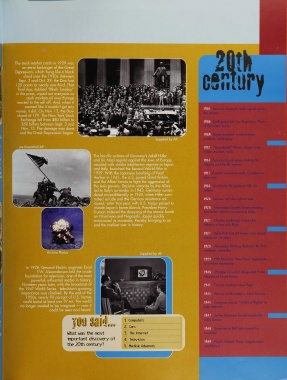
The stock market crash in 1929 was
an eerie harbinger of the Great
Depression, which hung like a black
cloud over the 1930s. Between
Sept. 3 and Oct. 29, the Dow lost
120 points or nearly one third. That
final day, dubbed "Black Tuesday"
in the press, wiped out everyone as
stock markets all over Europe
reacted to the sell off. And, when it
seemed like it couldn't get any
worse, it did. On Nov, 13, tne Dow
closed at 199. The New York Stock
Exchange fell from $8 0 billion to
$50 billion between Sept. 3 and
Nov. 13. The damage was done
and the Great Depression began.
Supplied by AP
Joe Rosenthal/AP
The horrific actions of Germany's Adolf Hitler
and his N a zi regime against the Jews of Europe, 1914
coupled with sim ilar totalitarian regimes in Japan
and Italy, launched the Second World W ar in
1 939. W ith the Japanese bombing of Pearl 1917
Harbor in 1941, the U.S. joined Great Britain
and the Allied Forces to fight the aggression of
the A xis powers. Decisive victories by the Allies 1918
led to Italy's surrender in 1943. Germany surren
dered unconditionally in 1945, when Hitler com
mitted suicide and the German resistance col 192 Q
lapsed. Later that year, with U.S. troops poised to
invade Japan's home islands, President Harry 192 Q
Truman ordered the dropping of the atomic bomb
on Hiroshima and Nagasaki. Japan quickly
announced its surrender, thereby bringing to an 192 7
end the costliest war in history.
1927
1928
Archive Photos
1933
In 1928, General Electric engineer Ernst
F.W. Alexanderson laid the crude 194Q
foundation for television, one of the most
powerful, influential media in history.
Nineteen years later, with the broadcast of 1941
the 1947 W orld Series, television's growing
importance was clinched. By the end of the 1945
1950s, nearly 90 percent of U.S. homes
could boast at least one TV set. The world 1945
no longer needed to be imagined — now it
could be seen and heard.
1947
1948
1949

