Page 73 - 2000
P. 73

Supplied by AP


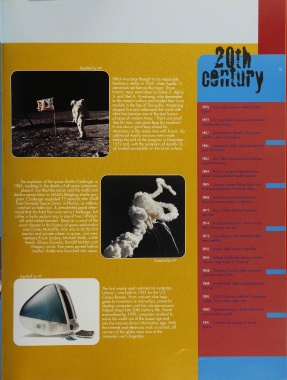
                                                        W hat was once thought to  be  impossible
                                                        became a  reality in  1969,  when Apollo  11
                                                        astronauts  set foot on  the  moon.  Those
                                                        historic  steps were taken  by Edwin  E.  Aldrin
                                                        Jr.  and  Neil  A.  Armstrong, who descended
                                                        to the  moon's  surface and  landed  their lunar
                                                        module  in  the  Sea  of Tranquility.  Armstrong
                                                                                                    1958
                                                        stepped  first and  addressed  the world with
                                                        what has  become one of the  best-known
                                                        phrases of modern  times:  "That's one  small
                                                                                                    1953
                                                        step  for man,  one giant leap for mankind."
                                                        It was also a  giant leap ahead  for
                                      A                 Americans  in  the  space  race with  Russia.  S ix
                                  -V  '3                additional  Apollo  missions were  made     1957
                              "                   ■     before the end  of the  program  in  December
                                                        1972  and,  with  the exception  of Apollo  13,
                                                                                                    1961
                                                        all  landed  successfully on  the  lunar surface.
                                                                                                    1962


                                                                                                    1964

           The explosion  of the  space  shuttle Challenger  in
                                                                                                    1965
        1986,  resulting  in  the  deaths  of all  seven  astronauts
           aboard,  horrified  the  nation  and  the world and
        dealt a  severe  blow to  NA SA 's  fledgling  shuttle  pro­
                                                                                                    1968
         gram.  Challenger exploded  73  seconds after liftoff
         from  Kennedy Space Center  in  Florida,  as  millions
         watched  on  television.  A  presidential  panel  deter­
                                                                                                    1973
        mined  that the  fatal  flaw was  not  in  Challenger,  but
         rather a  faulty  sealant  ring  in  one of two  149-foot-
           tall  solid  rocket boosters.  Dead  as  a  result of the
                                                                                                    1974
          worst disaster  in  the  history of space  exploration
            was Christa  McAuliffe,  who was to  be the first
            teacher and  private citizen  in  space,  and  crew
                                                                                                    1978
            members  Frank  Scobee,  Michael  Smith, Judith
             Resnik,  Ellison  Onizuka,  Ronald  M cNair and
                Gregory Jarvis.  Two years  passed  before                                          1981
                another  shuttle was  launched  into  space.  *    w 'w t
                                                                                                    1985
                                                                            Supplied  by AP

                                                                                                    1986


                                                                                                    1989
                                                   The  first widely  used  commercial  computer,
                                                   Univac  I, was  built in  1951  for the  U.S.
                                                   Census  Bureau.  From  vacuum  tube  logic       1991
                                                   gates to  transistors to  microchips,  powerful
                                                   desktop  computers  and  tiny  microprocessors
                                                   helped  shape  late  20th  Century  life.  Found   1993
                                                   everywhere  by  1990,  computers  evolved  to
                                                   move  the w orld  out of the  space  age  and
                                                   into the  Internet-driven  information  age.  W ith   19-97
                                                   the  Internet and  electronic  mail,  or e-mail,  all
                                                   corners  of the globe were  now at the
                                                   computer-user's  fingertips.
   68   69   70   71   72   73   74   75   76   77   78