


Page 72 - 2000
P. 72
Supplied by AP
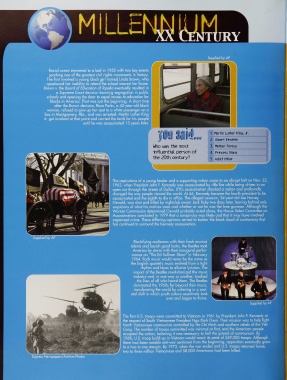
Racial unrest simmered to a boil in 1955 with two key events
sparking one of the greatest civil rights movements in history.
The first involved a young black girl named Linda Brown, who
questioned her inability to attend the school nearest her home.
B ro w n v. the B o a rd o f E d u c a tio n o f To p e ka eventually resulted in
a Supreme Court decision banning segregation in public
schools and opening the door to equal access to education for
blacks in America. That was just the beginning. A short time
after the Brown decision, Rosa Parks, a 42-year-old black
woman, refused to give up her seat to a white passenger on a
bus in Montgomery, Ala., and was arrested. Martin Luther King
Jr. got involved at that point and carried the torch for his people
until he was assassinated 13 years later.
the 20th century?
The aspirations of a young leader and a supporting nation came to an abrupt halt on Nov. 22,
1963, when President John F. Kennedy was assassinated by rifle fire while being driven in an
open car through the streets of Dallas. JFK's assassination shocked a nation and profoundly
changed the way people viewed the world. At 46, Kennedy became the fourth president to be
assassinated and the eighth to die in office. The alleged assassin, 24-year-old Lee Harvey
Oswald, was shot and killed by nightclub owner Jack Ruby two days later, leaving behind only
suspicions of what his motives were and whether or not he was the lone gunman. Although the
Warren Commission determined Oswald probably acted alone, the House Select Committee on
Assassinations concluded in 1979 that a conspiracy was likely and that it may have involved
organized crime. These differing opinions served to bolster the black cloud of controversy that
has continued to surround the Kennedy assassination.
Electrifying audiences with their fresh musical
talents and boyish good looks, the Beatles took
America by storm with their inaugural perfor
mance on "The Ed Sullivan Show" in February
1964. Rock music would never be the same as
the English quartet's music evolved from a tight
rhythm and blues to allusive lyricism. The
impact of the Beatles revolutionized the music
industry and, in one way or another, touched
the lives of all who heard them. The Beatles
dominated the 1960s far beyond their music,
transforming the world by ushering in a soci
etal shift in which youth culture assertively took
over and began to thrive.
The first U.S. troops were committed to Vietnam in 1961 by President John F. Kennedy at
the request of South Vietnamese President Ngo Dinh Diem. Their mission was to help fight
North Vietnamese communists controlled by Ho Chi Minh and southern rebels of the Viet
Cong. The number of troops committed was minimal at first, and the American people
accepted the action, believing it was necessary to halt the spread of communism. By
1968, U .S. troop build-up in Vietnam would reach its peak of 5 4 9 ,0 0 0 troops. Although
there had been notable anti-war sentiment from the beginning, opposition eventually grew
to a two to one margin. By 1973, when the war endeaand U.S. troops returned home,
two to three million Vietnamese and 5 8 ,0 0 0 Americans had been killed.
Express Newspapers/Archive Photos

