


Page 27 - pd282-May20-mag-web_Neat
P. 27
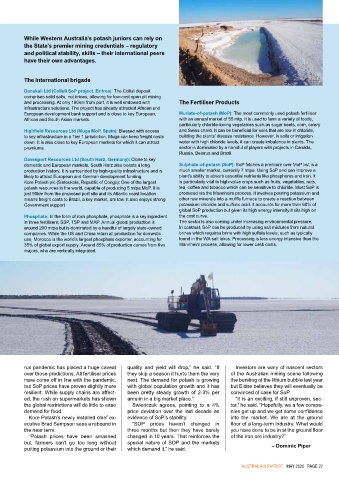
While Western Australia’s potash juniors can rely on
          the State’s premier mining credentials – regulatory
          and political stability, skills – their international peers
          have their own advantages.


          The international brigade
          Danakali Ltd (Colluli SoP project, Eritrea): The Colluli deposit
          comprises solid salts, not brines, allowing for low-cost open pit mining
          and processing. At only 180km from port, it is well endowed with   The Fertiliser Products
          infrastructure solutions. The project has already attracted African and
          European development bank support and is close to key European,   Muriate-of-potash (MoP): The most commonly used potash fertiliser
          African and South Asian markets.                      with an annual market of 55 mtp. It is used to farm a variety of foods,
                                                                particularly chloride-loving vegetables such as sugar beets, corn, celery
          Highfield Resources Ltd (Muga MoP, Spain): Blessed with access   and Swiss chard. It can be beneficial for soils that are low in chloride,
          to key infrastructure in a Tier 1 jurisdiction, Muga can keep freight costs   building the plants’ disease resistance. However, in soils or irrigation
          down. It is also close to key European markets for which it can attract   water with high chloride levels, it can create imbalance in plants. The
          premiums.                                             sector is dominated by a handful of players with projects in Canada,
                                                                Russia, Belarus and Brazil.
          Davenport Resources Ltd (South Harz, Germany): Close to key
          domestic and European markets, South Harz also boasts a long   Sulphate-of-potash (SoP): SoP fetches a premium over MoP but is a
          production history. It is surrounded by high-quality infrastructure and is   much smaller market, currently 7 mtpa. Using SoP and can improve a
          likely to attract European and German development funding.  plant’s ability to absorb essential nutrients like phosphorus and iron. It
          Kore Potash plc (Sintoukola, Republic of Congo): One of the largest   is particularly vital to high-value crops such as fruits, vegetables, nuts,
          potash resources in the world, capable of producing 5 mtpa MoP. It is   tea, coffee and tobacco which can be sensitive to chloride. Most SoP is
          just 90km from the proposed port site and its Atlantic coast location   produced via the Mannheim process. It involves pouring potassium and
          means freight costs to Brazil, a key market, are low. It also enjoys strong   other raw minerals into a muffle furnace to create a reaction between
          Government support.                                   potassium chloride and sulfuric acid. It accounts for more than 60% of
                                                                global SoP production but given its high energy intensity it sits high on
          Phosphate: In the form of rock phosphate, phosphate is a key ingredient   the cost curve.
          in three fertilisers; SSP, TSP and MAP. Annual global production is   The sector is also coming under increasing environmental pressure.
          around 200 mtpa but is dominated by a handful of largely state-owned   In contrast, SoP can be produced by using salt mixtures from natural
          companies. While the US and China retain all production for domestic   brines which requires brine with high sulfate levels, such as typically
          use, Morocco is the world’s largest phosphate exporter, accounting for   found in the WA salt lakes. Processing is less energy intensive than the
          35% of global export supply. Around 85% of production comes from five   Mannheim process, allowing for lower cash costs.
          majors, who are vertically integrated.


          rus pandemic has placed a huge caveat   quality and yield will drop,” he said. “If   Investors are wary of nascent sectors
          over those predictions. All fertiliser prices   they skip a season it hurts them the very   of the Australian mining scene following
          have come off in line with the pandemic,   next. The demand for potash is growing   the bursting of the lithium bubble last year
          but SoP prices have proven slightly more   with global population growth and it has   but Eidne believes they will eventually be
          resilient. While supply chains are affect-  been pretty steady growth of 2-3% per   convinced of case for SoP.
          ed, the rush on supermarkets has shown   annum in a big market place.”    “It is an exciting, if still unproven, sec-
          the global restrictions will do little to ease   Swiericzuk agrees, pointing to a 4%   tor,” he said. “Hopefully, we a few compa-
          demand for food.                    price deviation over the last decade as   nies get up and we get some confidence
           Kore Potash’s newly installed chief ex-  evidence of SoP’s stability.  into the market. We are at the ground
          ecutive Brad Sampson sees a rebound in   “SOP prices haven’t changed in   floor of a long-term industry. What would
          the near term.                      three months but then they have barely   you have done to be in at the ground floor
           “Potash prices have been smashed   changed in 10 years. That reinforces the   of the iron ore industry?”
          but, farmers can’t go too long without   special nature of SOP and the markets
          putting potassium into the ground or their   which demand it,” he said.               – Dominic Piper


                                                                                      aUSTRaLIa’S PaYDIRT   MaY 2020   Page 27

