


Page 206 - First Aid for the USMLE Step 1 2020, Thirtieth edition [MedicalBooksVN.com]_Neat
P. 206
162         SEcTioN ii    Microbiology  ` microbiology—Virology                                                                                                       Microbiology  ` microbiology—Virology


                `  microbiology—Virology

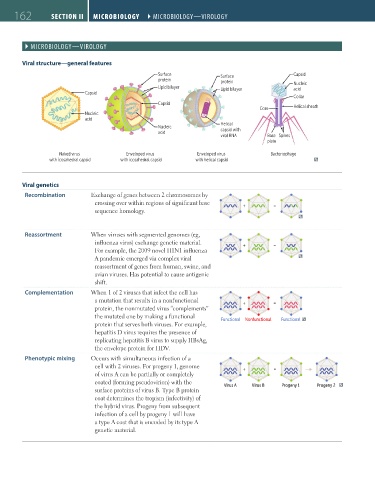
               Viral structure—general features

                                                           Surface              Surface                Capsid
                                                           protein              protein                Nucleic
                                                           Lipid bilayer        Lipid bilayer          acid
                                   Capsid
                                                                                                       Collar
                                                           Capsid
                                                                                            Core       Helical sheath
                                   Nucleic
                                   acid
                                                                                Helical
                                                           Nucleic
                                                           acid                 capsid with
                                                                                viral RNA      Base Spikes
                                                                                               plate
                           Naked virus           Enveloped virus        Enveloped virus         Bacteriophage
                        with icosahedral capsid   with icosahedral capsid  with helical capsid


               Viral genetics
                Recombination        Exchange of genes between 2 chromosomes by
                                       crossing over within regions of significant base    +     =
                                       sequence homology.


                Reassortment         When viruses with segmented genomes (eg,
                                       influenza virus) exchange genetic material.      +        =
                                       For example, the 2009 novel H1N1 influenza
                                       A pandemic emerged via complex viral
                                       reassortment of genes from human, swine, and
                                       avian viruses. Has potential to cause antigenic
                                       shift.
                Complementation      When 1 of 2 viruses that infect the cell has
                                       a mutation that results in a nonfunctional       +        =
                                       protein, the nonmutated virus “complements”
                                       the mutated one by making a functional   Functional Nonfunctional  Functional
                                       protein that serves both viruses. For example,
                                       hepatitis D virus requires the presence of
                                       replicating hepatitis B virus to supply HBsAg,
                                       the envelope protein for HDV.
                Phenotypic mixing    Occurs with simultaneous infection of a
                                       cell with 2 viruses. For progeny 1, genome       +        =
                                       of virus A can be partially or completely
                                       coated (forming pseudovirion) with the    Virus A  Virus B   Progeny 1  Progeny 2
                                       surface proteins of virus B. Type B protein
                                       coat determines the tropism (infectivity) of
                                       the hybrid virus. Progeny from subsequent
                                       infection of a cell by progeny 1 will have
                                       a type A coat that is encoded by its type A
                                       genetic material.


          FAS1_2019_03-Microbiology.indd   162                                                                         11/14/19   12:21 PM

