


Page 213 - First Aid for the USMLE Step 1 2020, Thirtieth edition [MedicalBooksVN.com]_Neat
P. 213
Microbiology ` microbiology—Virology Microbiology ` microbiology—Virology SEcTioN ii 169
Influenza viruses Orthomyxoviruses. Enveloped, ⊝ ssRNA Reformulated vaccine (“the flu shot”) contains
viruses with 8-segment genome. Contain viral strains most likely to appear during the flu
hemagglutinin (binds sialic acid and promotes season, due to the virus’ rapid genetic change.
viral entry) and neuraminidase (promotes Killed viral vaccine is most frequently used.
progeny virion release) antigens. Patients at Live attenuated vaccine contains temperature-
risk for fatal bacterial superinfection, most sensitive mutant that replicates in the nose but
commonly S aureus, S pneumoniae, and not in the lung; administered intranasally.
H influenzae. Treatment: supportive +/– neuraminidase
inhibitor (eg, oseltamivir, zanamivir).
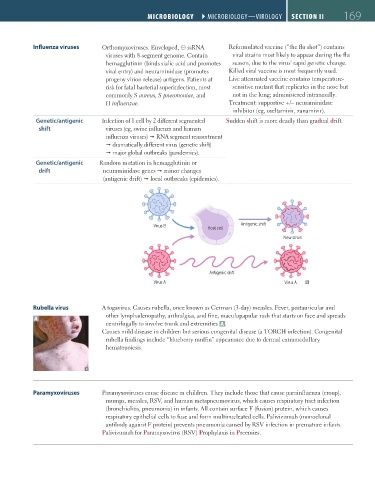
Genetic/antigenic Infection of 1 cell by 2 different segmented Sudden shift is more deadly than gradual drift.
shift viruses (eg, swine influenza and human
influenza viruses) RNA segment reassortment
dramatically different virus (genetic shift)
major global outbreaks (pandemics).
Genetic/antigenic Random mutation in hemagglutinin or
drift neuraminidase genes minor changes
(antigenic drift) local outbreaks (epidemics).
Virus B Host cell Antigenic shift
New strain
Antigenic drift
Virus A Virus A
Rubella virus A togavirus. Causes rubella, once known as German (3-day) measles. Fever, postauricular and
other lymphadenopathy, arthralgias, and fine, maculopapular rash that starts on face and spreads
A
centrifugally to involve trunk and extremities A .
Causes mild disease in children but serious congenital disease (a TORCH infection). Congenital
rubella findings include “blueberry muffin” appearance due to dermal extramedullary
hematopoiesis.
Paramyxoviruses Paramyxoviruses cause disease in children. They include those that cause parainfluenza (croup),
mumps, measles, RSV, and human metapneumovirus, which causes respiratory tract infection
(bronchiolitis, pneumonia) in infants. All contain surface F (fusion) protein, which causes
respiratory epithelial cells to fuse and form multinucleated cells. Palivizumab (monoclonal
antibody against F protein) prevents pneumonia caused by RSV infection in premature infants.
Palivizumab for Paramyxovirus (RSV) Prophylaxis in Preemies.
FAS1_2019_03-Microbiology.indd 169 11/14/19 12:22 PM

