


Page 312 - First Aid for the USMLE Step 1 2020, Thirtieth edition [MedicalBooksVN.com]_Neat
P. 312
268         SectiOn ii    Public HealtH ScienceS  ` PUBLIC HEALTH SCIENCES—ETHICS                                                                     Public HealtH ScienceS  ` PUBLIC HEALTH SCIENCES—ETHICS


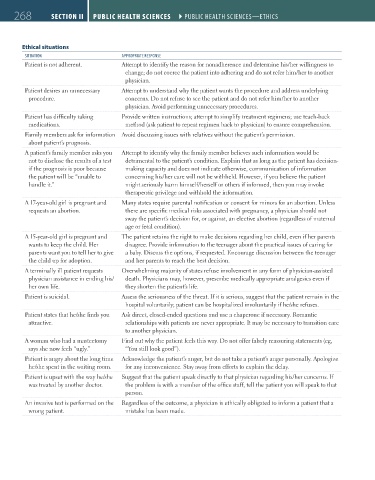
               Ethical situations
                SITUATIoN                      APPRoPRIATE RESPoNSE
                Patient is not adherent.       Attempt to identify the reason for nonadherence and determine his/her willingness to
                                                 change; do not coerce the patient into adhering and do not refer him/her to another
                                                 physician.
                Patient desires an unnecessary   Attempt to understand why the patient wants the procedure and address underlying
                 procedure.                      concerns. Do not refuse to see the patient and do not refer him/her to another
                                                 physician. Avoid performing unnecessary procedures.
                Patient has difficulty taking   Provide written instructions; attempt to simplify treatment regimens; use teach-back
                 medications.                    method (ask patient to repeat regimen back to physician) to ensure comprehension.
                Family members ask for information  Avoid discussing issues with relatives without the patient’s permission.
                 about patient’s prognosis.
                A patient’s family member asks you   Attempt to identify why the family member believes such information would be
                 not to disclose the results of a test   detrimental to the patient’s condition. Explain that as long as the patient has decision-
                 if the prognosis is poor because   making capacity and does not indicate otherwise, communication of information
                 the patient will be “unable to   concerning his/her care will not be withheld. However, if you believe the patient
                 handle it.”                     might seriously harm himself/herself or others if informed, then you may invoke
                                                 therapeutic privilege and withhold the information.

                A 17-year-old girl is pregnant and   Many states require parental notification or consent for minors for an abortion. Unless
                 requests an abortion.           there are specific medical risks associated with pregnancy, a physician should not
                                                 sway the patient’s decision for, or against, an elective abortion (regardless of maternal
                                                 age or fetal condition).
                A 15-year-old girl is pregnant and   The patient retains the right to make decisions regarding her child, even if her parents
                 wants to keep the child. Her    disagree. Provide information to the teenager about the practical issues of caring for
                 parents want you to tell her to give   a baby. Discuss the options, if requested. Encourage discussion between the teenager
                 the child up for adoption.      and her parents to reach the best decision.
                A terminally ill patient requests   Overwhelming majority of states refuse involvement in any form of physician-assisted
                 physician assistance in ending his/  death. Physicians may, however, prescribe medically appropriate analgesics even if
                 her own life.                   they shorten the patient’s life.
                Patient is suicidal.           Assess the seriousness of the threat. If it is serious, suggest that the patient remain in the
                                                 hospital voluntarily; patient can be hospitalized involuntarily if he/she refuses.

                Patient states that he/she finds you   Ask direct, closed-ended questions and use a chaperone if necessary. Romantic
                 attractive.                     relationships with patients are never appropriate. It may be necessary to transition care
                                                 to another physician.
                A woman who had a mastectomy   Find out why the patient feels this way. Do not offer falsely reassuring statements (eg,
                 says she now feels “ugly.”      “You still look good”).
                Patient is angry about the long time   Acknowledge the patient’s anger, but do not take a patient’s anger personally. Apologize
                 he/she spent in the waiting room.  for any inconvenience. Stay away from efforts to explain the delay.
                Patient is upset with the way he/she   Suggest that the patient speak directly to that physician regarding his/her concerns. If
                 was treated by another doctor.  the problem is with a member of the office staff, tell the patient you will speak to that
                                                 person.

                An invasive test is performed on the   Regardless of the outcome, a physician is ethically obligated to inform a patient that a
                 wrong patient.                  mistake has been made.


          FAS1_2019_06-PubHealth.indd   268                                                                             11/7/19   4:16 PM

